Driving a Moving Truck in Winter, Rain, or High Wind
A big loaded box truck handles nothing like your car when the weather turns. Here's how to drive one safely through snow, rain, and high wind. Plus when the smart, cheap move is to simply wait the storm out.
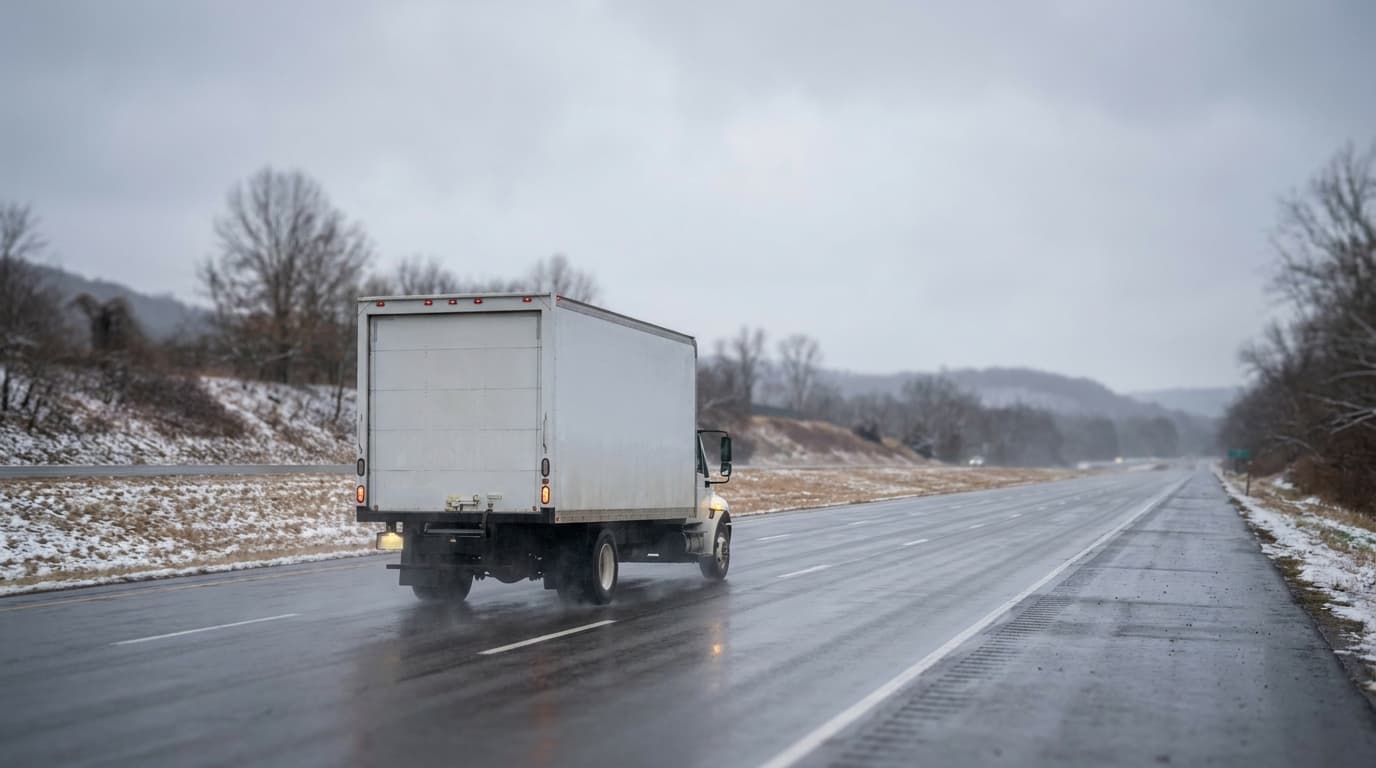
Moving day rarely waits for perfect weather. You booked the truck weeks ago, the helpers are lined up, the lease is up. And then the forecast turns to snow, driving rain, or a wind advisory. The temptation is to grit your teeth and push through. Sometimes that's fine. Sometimes it's a genuinely bad idea.
The thing to understand up front is that a loaded moving truck is not a bigger car. It handles much worse than your car when the roads are slick or the wind is up. This guide explains why, walks through each type of bad weather, and gives you the plain rules that keep everyone safe. The most important one: it's okay to delay a move.
The short version
If you only read one section, read this:
- A big loaded truck is heavy, tall, and stops slowly. It needs far more room to slow down and is easily pushed around by wind.
- In any bad weather, slow down and double your following distance. The truck can't react quickly for you, so give yourself room to react.
- Make every input smooth. Brake, steer, and accelerate gently and gradually. Sudden moves are what put a heavy truck out of control.
- Skip cruise control on wet, snowy, or icy roads. You want full control of the throttle.
- Clear all snow and ice off the truck before you drive: roof, hood, lights, and mirrors.
- Watch bridges and open stretches for black ice and for sudden crosswinds.
- Check the forecast, carry a basic emergency kit, and never be afraid to wait out a storm. A delayed move is cheaper than a wrecked one.
Everything below is these ideas in detail.
Why a loaded truck handles worse in bad weather
Before the specific conditions, it helps to know why a box truck is such a handful when the weather's bad. Four things work against you:
It's heavy. A loaded truck can weigh several times what your car does. All that mass wants to keep moving in a straight line, so it takes much longer to stop and to change direction.
It has a high center of gravity. A tall cargo box sitting up over the wheels makes the truck prone to leaning, swaying, and, in the worst case, tipping. A hard swerve your car would shrug off can seriously unsettle a truck.
Its stopping distance is long. Between the weight and the brakes, a truck needs a lot more pavement to stop than you're used to, and a wet or icy surface grows that distance dramatically. Most people badly underestimate it.
It has a big flat side. The tall, flat wall of the cargo box acts like a sail. A gust of wind (or the wake off a passing semi) pushes on that surface and shoves the truck sideways, especially when it's lightly loaded.
Keep those four facts in mind and every rule below makes sense. Our guide to driving a moving truck covers the fundamentals for good weather; this guide is what changes when conditions get worse.
Wet and winter driving: the universal rules
Most of safe bad-weather driving isn't about any one condition. It's a handful of habits for any time the road is less than dry and clear.
Slow down. This is the single most effective thing you can do. Posted speed limits assume dry roads and a normal vehicle; in a heavy truck on a slick surface, well under the limit is often the right speed.
Double your following distance. The gap you'd leave in your car isn't enough. Because the truck weighs more and stops slower, treat double your usual following distance as a starting point, and leave more if it's really bad.
Make every input smooth and gradual. Brake gently and early, steer smoothly, and accelerate slowly. A heavy truck stays composed when you're gentle with it and gets unsettled when you're abrupt. When slowing, start sooner and squeeze the brakes progressively rather than stabbing at them.
Don't use cruise control on slick roads. Cruise control can keep feeding power to the wheels at exactly the wrong moment, for instance if a tire loses grip, and it takes throttle control out of your hands. On wet, snowy, or icy roads, drive it yourself.
Snow and ice
Snow and ice are the most demanding conditions you can face in a truck, and the ones where "should I even be driving today?" is a fair question.
Clear the whole truck before you move it. Brush snow and scrape ice off the roof of the cargo box, the hood, the windshield, all the lights, and the mirrors. Snow left on the roof slides forward onto your windshield when you brake and flies off onto the cars behind you, and clean lights and mirrors are what let others see you and you see them.
Watch for black ice, especially on bridges and overpasses. Bridges freeze before regular roads because cold air circulates above and below them, so a road that looks merely wet can be an ice sheet on a bridge deck. Ease off the gas before you reach one, keep the wheel steady, and don't brake or steer sharply while you're on it.
Give yourself even more room. Every universal rule gets more extreme on snow and ice: slower speeds, longer following distances, gentler inputs. Stopping distance on ice can be many times what it is on dry pavement.
Seriously consider delaying. If roads are snow-covered or icy, plows haven't been through, or there's an advisory to stay off the roads, the right call may be to wait a day. A heavy, unfamiliar truck on ice is a lot to ask of any driver, and there's no shame in pushing the move back. See the best time to rent a moving truck for how weather and timing factor into planning.
Rain
Rain feels routine, but it changes how a truck behaves more than people expect.
Turn your headlights on. In many places it's the law any time your wipers are running, and it makes a tall truck far easier for other drivers to see in gray, low-visibility conditions.
Watch for hydroplaning. When there's enough water on the road, your tires can ride up on top of it and lose contact with the pavement, and the truck starts to skim rather than grip. Slowing down is the best defense. If the steering goes light and vague, don't brake hard or jerk the wheel. Ease off the gas, hold steady, and let the tires settle back down.
Ease off the gas in standing water. Big puddles and sheets of water across the road are exactly where hydroplaning happens, and they're common at low spots and underpasses in heavy rain. Slow down before you reach them rather than braking in them, and never drive through water deep enough that you can't judge its depth. The first rain after a dry spell is the slickest of all, so give early storms extra respect.
High wind
Wind is the condition people forget about, and it's the one where a moving truck is uniquely vulnerable. That big flat cargo box is a sail, and the emptier the truck, the more the wind can move it.
Grip the wheel firmly with both hands. Gusts arrive suddenly, and a firm, steady grip lets you make the small corrections that keep the truck tracking straight without over-reacting.
Slow down. The faster you're going when a gust hits, the more it moves you and the less time you have to correct.
Expect crosswinds on open stretches and bridges. Wind hits hardest where there's nothing to block it: open highway, farmland, high bridges, and gaps between buildings. Be ready as you move from a sheltered area into an exposed one; the change can be abrupt.
Anticipate the wake off passing trucks. When a semi passes you (or you pass one), you'll feel a push. First away, then pulled toward it as it goes by. Keep both hands on the wheel and correct smoothly. The same goes for buses and other tall vehicles.
A lightly loaded truck is the most exposed. Counterintuitively, a mostly empty truck gets shoved around far more than a full one, because there's less weight holding it down. In high wind, be extra cautious, and if there's a wind advisory for high-profile vehicles, take it seriously.
Before you leave: forecast, route, and a kit
A little preparation prevents most bad-weather trouble.
Check the forecast and your whole route. Weather at your destination or over a mountain pass halfway there can be completely different from what's outside your window, so look at the entire route. And if you can, leave a few hours later to let plows run, morning ice melt, or a wind advisory lift.
Carry a basic emergency kit. An ice scraper, a phone charger, water and snacks, a flashlight, warm layers and a blanket, and a small first-aid kit cover most of what you'd want if you got stuck. If the truck itself gives you trouble, our breakdown guide covers what to do.
Give yourself extra time. Bad-weather driving is slower driving, and padding your schedule keeps you from rushing when rushing is exactly the wrong instinct. For bigger trips, our long-distance moving truck guide covers route and timing planning in depth.
The bottom line
A loaded moving truck is heavy, tall, slow to stop, and easily pushed by wind. So in snow, rain, or high wind you drive it with far more caution than your car: slower, with more following distance, with smooth and gradual inputs, and without cruise control on slick roads. Clear the snow and ice off before you roll, respect bridges and open stretches, and keep both hands on the wheel when it's windy.
Most of all, remember that the schedule is negotiable and your safety isn't. If the roads are bad, waiting a day is the cheapest insurance there is. No deadline is worth driving a truck you're not comfortable with.
Before your move, brush up on the fundamentals in our how to drive a moving truck guide, and if you're still planning your dates, see the best time to rent a moving truck to build weather margin into your schedule.
Not sure which truck to book?
Answer two quick questions and get a size recommendation, plus a side-by-side of how U-Haul, Penske, and Budget stack up.