One-Way vs. Round-Trip Truck Rental: Which Do You Need?
Two rental types, two completely different price structures. Picking the wrong one can cost you hundreds. Here's how one-way and round-trip rentals actually work, and how to know which one your move calls for.

Almost every moving-truck reservation starts with one fork in the road: are you bringing the truck back where you got it, or leaving it in a new town? That single choice, one-way or round-trip, changes which companies you can even use, how the price is built, and how much you'll ultimately pay. Get it wrong and the mistake is measured in hundreds of dollars, not a few bucks.
The confusing part is that the two options look almost identical on a rental website. Same trucks, same sizes, same counter. But under the hood they're priced in completely different ways, and the "cheaper" one on paper can be the far more expensive one for your actual move. This guide untangles the two so you book the right kind of rental the first time.
The short version
- Round-trip (local) rentals are for moving across town. You pick the truck up and return it to the same location. Priced as a low daily rate plus a per-mile charge.
- One-way rentals are for moving to a different city or state. You pick up in your old town, drop off near your new home, and never drive the truck back. Priced as a single flat rate that already bundles in a set number of days and the miles for your route.
- Use one-way any time you're leaving town. Using a round-trip rental for a long-distance move means driving the empty truck all the way back. That's the classic, expensive mistake.
- Only U-Haul, Penske, and Budget Truck do one-way consumer rentals nationally. Enterprise and Hertz box trucks generally have to come back to the branch you got them from.
- One-way prices swing based on which direction trucks are needed, so the same route can be priced very differently from week to week and company to company.
The two rental types, defined
A round-trip rental, often called a "local" rental, is a there-and-back deal. You collect the truck from a location, drive it wherever you need, and return it to that same location. The pricing has two parts: a modest daily rate (you're charged per day you keep the truck) and a per-mile charge for every mile you actually drive. Because the base rate is low, these are the cheapest option when the total mileage is small, which is exactly the case for a move across town.
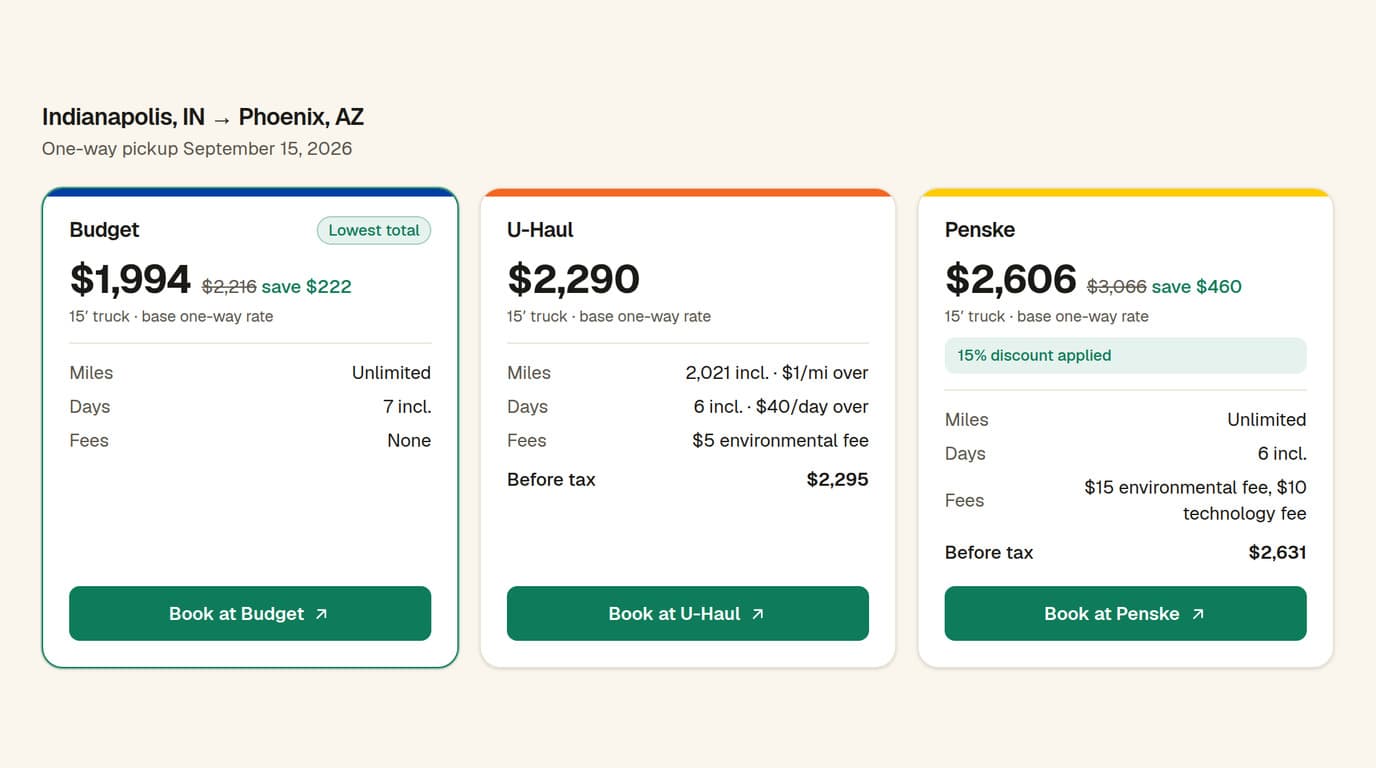
A one-way rental is a point-A-to-point-B deal. You pick the truck up in your departure city and drop it off at a different location near your destination. You do not bring it back. Instead of a daily-plus-mileage formula, one-way rentals are quoted as a single flat rate. That flat rate is designed to cover your specific route: it typically includes a set number of days to make the drive and a set number of miles based on the distance between your two cities. Go over the allotted days or miles and there are extra charges, but for a normal cross-country drive the included allowance is meant to fit.
The mental model that helps: round-trip is priced by how far you drive; one-way is priced by where you're going.
How the pricing really differs
Here's the same two structures side by side.
| Round-trip (local) | One-way | |
|---|---|---|
| Best for | Moves across town | Moves to another city/state |
| Where you return it | Same location you picked up | A different location near your destination |
| How it's priced | Low daily rate + per-mile charge | Single flat rate |
| Miles | You pay for each mile driven | A set allowance for your route is included |
| Days | Charged per day | A set number of days is included |
| Drive the truck back? | Yes | No |
The reason the distinction matters so much is that each structure is cheap in one scenario and brutal in the other. A round-trip rental with its low daily rate is a bargain when you're only driving twenty miles total. But that same per-mile charge, multiplied across a 900-mile relocation and then doubled for the return drive, turns into a number no one wants to see. A one-way flat rate looks expensive next to a local daily rate, until you remember it already includes the days, the miles, and the fact that you never have to make a return trip.
If you want to see how these structures translate into real numbers for your situation, our moving truck rental cost guide breaks down the line items, and the moving cost estimator will ballpark your total in a few clicks.
When each one makes sense
Reach for a round-trip (local) rental when:
- You're moving within the same town or metro area.
- You'll return the truck to where you started, ideally the same day or next day.
- Your total driving is low. Think a few loads across town, not a highway haul.
- You're using the truck for something short-term: a dump run, a furniture pickup, a small in-town move.
Reach for a one-way rental when:
- You're moving to a different city or state.
- Driving the truck back would be impractical, expensive, or impossible (you're not returning to your old city).
- You want the certainty of a flat price rather than watching a mileage meter tick up.
- Your move is long enough that a round-trip's per-mile charges would balloon.
The dividing line is almost always the same simple question: am I coming back to this city? If the answer is no, you want one-way.
The classic expensive mistake
Every moving season, people try to save money by booking a cheap-looking round-trip rental for a long-distance move. It backfires badly.
Picture a move from Denver to Chicago, roughly 1,000 miles. Someone sees a low local daily rate plus a per-mile charge and thinks it looks affordable. But a round-trip rental has to come back to Denver. That means after unloading in Chicago, they'd have to drive the empty truck 1,000 miles back to Denver, burning another tank after tank of fuel, another two days, and racking up per-mile charges on all 2,000 miles. Then they'd need to get themselves back to Chicago somehow.
A one-way rental exists precisely to avoid this. You drop the truck in Chicago and walk away. Even when the one-way flat rate looks higher than the local daily rate at first glance, it is almost always dramatically cheaper for a long-distance move once you account for the double mileage, the extra days, the extra fuel, and the return trip you'd otherwise have to make.
The rule of thumb: if your destination is far enough that you wouldn't want to drive an empty truck home from it, you need one-way. Full stop.
Which companies actually do one-way
This is where your options narrow. Not every rental company will let you drop a truck off in a different city.
- U-Haul, Penske, and Budget Truck are the three national companies that offer one-way consumer moving-truck rentals. If you're relocating to a new city, these are effectively your choices, and it's worth pricing all three.
- Enterprise and Hertz rent box trucks too, but their truck rentals generally must be returned to the originating branch. That makes them a fine choice for a local, round-trip move, but generally not an option for a one-way relocation to another city.
So for a local move, you have more companies to consider. For a one-way move, you're realistically comparing U-Haul, Penske, and Budget. Our side-by-side comparison lines those three up on fleet, sizes, mileage, and pricing so you can see who fits your route.
Drop-off flexibility and why one-way prices swing
Two more things worth understanding before you book a one-way rental.
Drop-off location. With a one-way rental, you don't always get to name the exact drop-off spot. The company assigns you a return location (or a short list of them) near your destination, based on where they have capacity. Usually there's a convenient option, but if you have a strong preference (say, a location close to your new place), confirm it when you book rather than assuming.
Fleet imbalance = shifting prices. One-way rates aren't fixed the way a local daily rate is. They rise and fall based on how badly each company needs trucks moved in your direction. If lots of people are leaving your city, trucks are scarce there and prices go up. If the company is short on trucks in your destination city, they may discount a one-way rental to get one delivered there for free. This imbalance shifts week to week and differs between U-Haul, Penske, and Budget. That's exactly why the same route can produce three very different quotes.
The practical move: always price all three companies for a one-way trip, and check more than once as your date approaches. Timing matters too. Our guide on the best time to rent covers the seasonal and day-of-week swings that stack on top of fleet imbalance.
Mistakes worth avoiding
- Booking round-trip for a long-distance move. The empty return drive erases any apparent savings and then some. If you're leaving town, book one-way.
- Assuming the flat one-way rate is a rip-off. It bundles days, miles, and no return trip. Compare it against the full cost of a round-trip, not just the daily rate.
- Only checking one company for a one-way move. Fleet imbalance means U-Haul, Penske, and Budget can quote wildly different prices for the identical route. Check all three.
- Trying to book a one-way with Enterprise or Hertz. Their box trucks generally must return to the originating branch. Fine for local, not for relocations.
- Overlooking days and miles included. On a one-way rental, confirm the allowance actually covers your route so you don't get hit with overage charges.
- Sorting out the rental type but skipping the size. The right size still matters just as much. Use our truck size calculator or read the full size guide.
The bottom line
The choice comes down to one honest question: are you bringing this truck back to where you got it? If yes, a round-trip (local) rental with its low daily rate plus mileage is your cheapest path. If no (you're relocating to a new city), you want a one-way rental, and you want to compare U-Haul, Penske, and Budget, because a flat rate that already includes your days and miles beats driving an empty truck halfway across the country every single time.
New to all of this? Start with our step-by-step rental walkthrough. Ready to price your move? Estimate your total cost, then compare U-Haul, Penske, and Budget for your exact route.
Not sure which truck to book?
Answer two quick questions and get a size recommendation, plus a side-by-side of how U-Haul, Penske, and Budget stack up.