Long-Distance Moving Truck Guide: Renting for a Cross-Country Move
Everything that changes when the move is 1,000+ miles instead of across town: why one-way is non-negotiable, how mileage and days work, and how to budget for the fuel a box truck really drinks on the interstate.
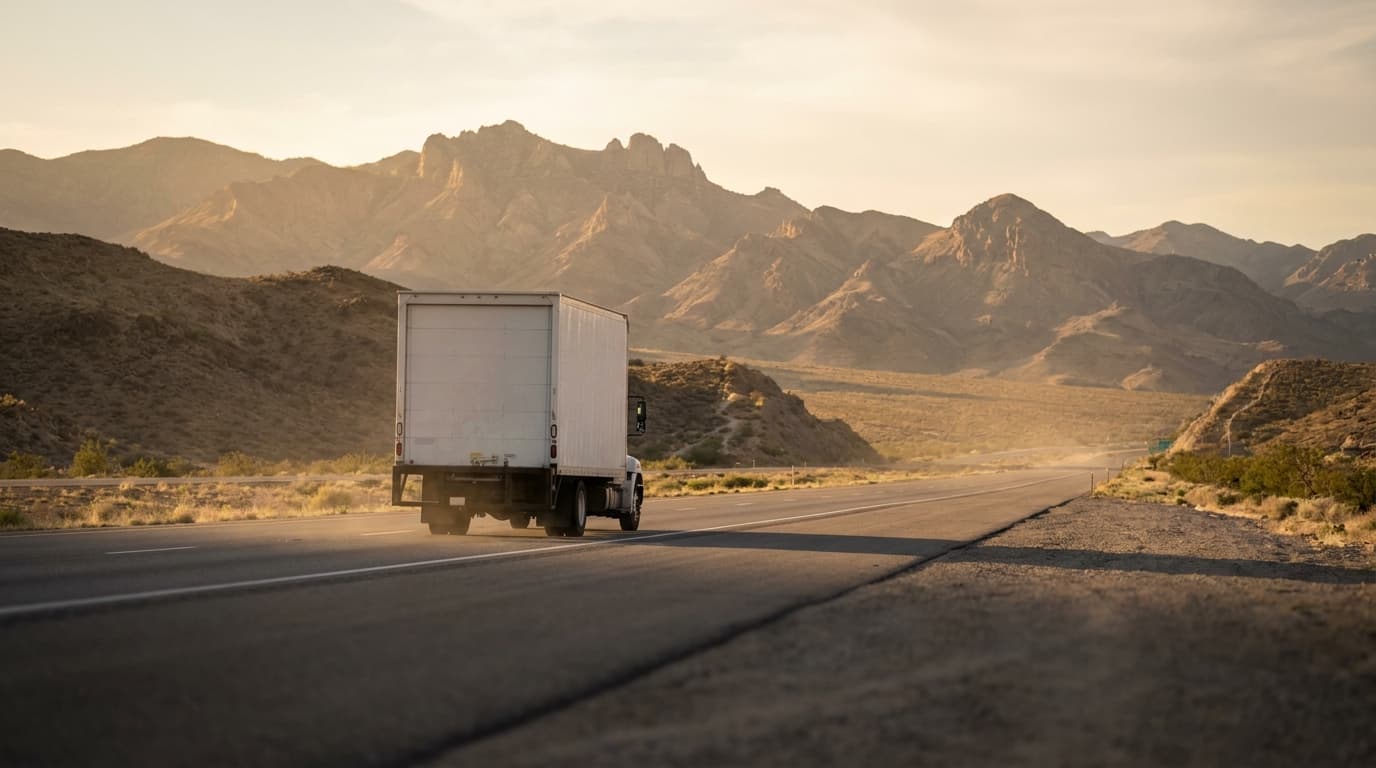
A cross-country move is a different animal from a move across town. The truck is the same, but almost everything around it changes: how you're billed, how you plan the route, how much you'll spend on fuel, and how much room for error you have. A too-small truck or a missed detail on a local move is an annoyance. On a 1,800-mile move, the same mistake can cost you days and hundreds of dollars, because there's no popping back for a second load.
This guide walks through the whole long-distance process so you can book the right truck, plan a realistic route, and budget honestly for what a move across the country actually costs.
The short version
If you're driving your own household goods a long distance, here's the shape of it:
- You want a one-way rental, always. You pick up near your old home and drop off near your new one. You never drive the empty truck back.
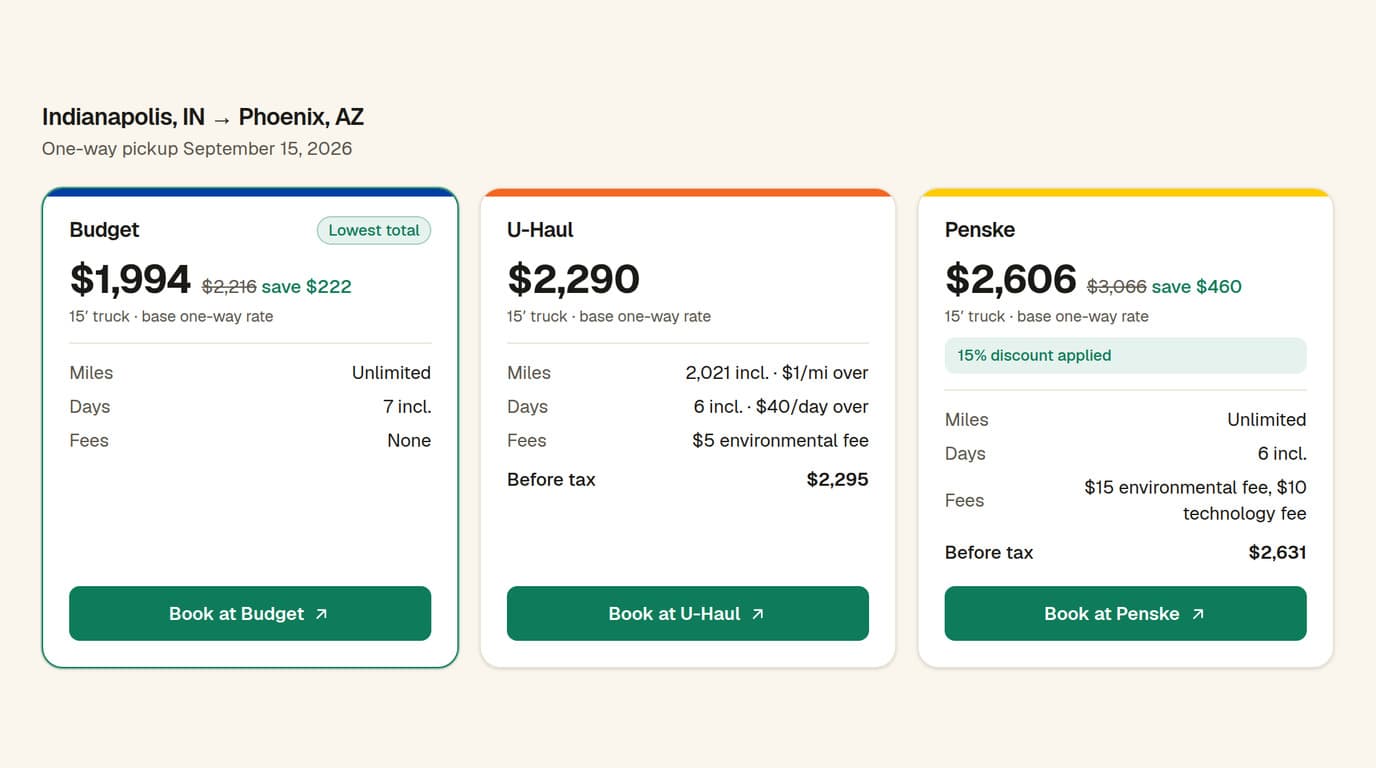
- Only three companies do one-way: U-Haul, Penske, and Budget Truck. Compare all three; their rates for the same route can differ by hundreds of dollars.
- Size up so everything fits in a single trip. On a long move there is no second trip, so leftover items get left behind or shipped separately.
- The one-way rate bundles a set number of days and miles for your specific route. Know your allowances, because going over costs extra per day and per mile.
- Fuel is a major line item. Box trucks get roughly 8–12 mpg, so a cross-country haul can burn hundreds of dollars in gas by itself.
- Book early for both price and availability. One-way trucks are a finite pool.
Everything below fills in the details.
Why one-way is essential
On a local move you can debate one-way versus round-trip. On a cross-country move there's nothing to debate.
A round-trip (local) rental means you return the truck to the same place you got it. Rent one for a move to another state and you'd unload at your new home, then drive the empty truck all the way back to the origin city to return it, doubling your miles, your fuel, and your days on the road for no reason. It essentially never makes financial sense.
A one-way rental is built for exactly this trip: you pick up in your origin city, drive the loaded truck to your destination, and drop it at a location near your new home. You never see the origin again. The price is a single flat rate that already includes a set number of days and miles for the route.
So for any real move to a new city or state, one-way is the only sensible choice. Our one-way vs. round-trip breakdown covers the trade-offs in more depth, but for cross-country the verdict is simple.
One consequence worth internalizing now: only U-Haul, Penske, and Budget Truck rent one-way to consumers. Enterprise and Hertz rent box trucks, but generally require you to return them to the same branch, which rules them out for a move to a new city. That leaves three companies to compare, and comparing them matters, because one-way pricing swings with how badly each company needs trucks moved in your direction. See how they line up on our comparison page.
Size up, because there is no second trip
On a local move, guessing too small costs you a second run across town. On a long-distance move, there is no second trip. Whatever doesn't fit gets left behind, sold, or shipped separately at added cost. That single fact should push every long-haul renter toward the larger size when they're on the fence.
The usual buckets still apply: a small (10–12') truck for a studio or one-bedroom, a medium (15–16') for two bedrooms, a large (20–22') for three bedrooms, and the 26-footer for a full four- or five-bedroom house. But for a cross-country move, add a margin. Closets, the garage, and the basement always hold more than people expect, and you only get one shot to load it all.
When you're genuinely between sizes on a long move, go up. The slightly higher one-way rate is cheap insurance against the far worse outcome of stranded belongings. Our truck size guide breaks down each option room by room, and if you're new to the whole process, how to rent a moving truck covers the fundamentals.
What the one-way rate includes (and what "going over" costs)
This is the part local movers never have to think about. A one-way rate is a flat price built around two allowances tied to your specific route:
- A set number of days to complete the move, often calculated from the realistic driving distance, with a buffer. A coast-to-coast trip might come with, say, a week; a shorter regional move, just a few days.
- A set number of miles: typically the direct route mileage between your pickup and drop-off points, sometimes with a small cushion.
Stay within both and you pay the quoted flat rate. Exceed them and the extra is billed on top: a per-day charge for keeping the truck longer than allowed, and a per-mile charge for driving farther than the included distance. Those per-mile and per-day fees are exactly why sightseeing detours and slow-loading days can quietly inflate a bill.
Two practical habits keep you inside the lines. First, when you book, confirm in writing how many days and miles your rate includes. Second, plan a route that fits. If your scenic detour adds 200 miles, know that those miles may not be free. For a ballpark of the whole one-way cost before you commit, run your route through our moving cost estimator, and see our rental cost guide for how the pieces add up.
Planning the route and your overnight stops
A cross-country drive in a loaded box truck is slower and more tiring than the same trip in your car. The truck tops out lower, climbs grades slowly, and needs longer to stop. Plan around that reality rather than your normal road-trip pace.
A sensible daily target for most people is 300–500 miles, or roughly 6–9 hours of actual driving once you factor in fuel stops, meals, and fatigue. Pushing much past that in an unfamiliar heavy vehicle is where mistakes happen. Here's how that maps to common distances:
| Route distance | Rough driving time | Realistic days on the road |
|---|---|---|
| ~500 miles | 9–11 hours | 1–2 days |
| ~1,000 miles | 18–22 hours | 2–3 days |
| ~1,800 miles | 32–38 hours | 4–5 days |
| ~2,800 miles (coast to coast) | 50–58 hours | 6–8 days |
Build your overnight stops in advance. When you book a room, factor in truck parking. A loaded moving truck won't fit in a standard hotel space, so look for properties with large or lot-style parking, and try to park where you can see the truck. Overnight security is a real concern with everything you own inside: park in well-lit areas, back up against a wall or another vehicle so the roll-up door can't be opened, use a good padlock on the cargo door, and never leave the truck loaded in an isolated spot. If you're towing your car, remember the combined length when you plan where to stop.
Before you set off, it's worth a few minutes with our guide to driving a moving truck. Height clearances, wide turns, and mountain grades all matter more over a long haul.
Budgeting for fuel, the cost people underestimate
Here's the number that surprises first-time long-distance movers: a box truck gets roughly 8–12 mpg, and worse when heavily loaded or fighting a headwind through the mountains. Over a couple thousand miles, fuel becomes one of the largest single costs of the entire move, sometimes rivaling the rental rate itself.
The math is simple enough to do on a napkin. Take your route miles, divide by the truck's mpg to get gallons, then multiply by the price per gallon. Most box trucks take regular gasoline; the largest may take diesel, so confirm before your first fill-up. Here's a ballpark across a range of fuel prices, assuming a middle-of-the-road 10 mpg:
| Route distance | Gallons (~10 mpg) | Fuel at ~$3.50/gal | Fuel at ~$4.50/gal |
|---|---|---|---|
| ~500 miles | ~50 | ~$175 | ~$225 |
| ~1,000 miles | ~100 | ~$350 | ~$450 |
| ~1,800 miles | ~180 | ~$630 | ~$810 |
| ~2,800 miles | ~280 | ~$980 | ~$1,260 |
These are illustrative examples, not quotes. Your actual mileage, load weight, terrain, and pump prices will move the numbers. Two adjustments make them more accurate for you: if you rent a bigger truck or load it heavy, budget nearer 8 mpg (worse fuel economy, so more gallons); and if you're towing a car, add a further penalty. When in doubt, estimate on the pessimistic side so the total is a pleasant surprise rather than a painful one.
Your car: tow it or ship it?
If you're moving the household yourself, your car has to get there too. You've got two broad options.
Tow it behind the truck. U-Haul, Penske, and Budget all rent tow dollies (front wheels up, rear wheels rolling) and car trailers (all four wheels off the ground). This keeps everything in one convoy and is usually the cheaper path. But it adds length, weight, and fuel burn, makes the truck harder to maneuver and back up, and rules out reversing with a tow dolly attached. Our guide to towing a car with a moving truck covers dolly-versus-trailer and how to do it safely.
Ship it separately with an auto-transport company. This costs more up front but spares you from driving a longer, heavier rig across the country and lets you and the car travel independently. For some people, especially on very long routes or with a car that can't be flat-towed, the reduced stress is worth the price.
Neither is universally right; weigh the towing savings against the added difficulty and fuel of hauling it yourself.
Insurance for a long haul
Coverage deserves extra attention when you'll be behind the wheel for days across multiple states. The key fact catches many people off guard: your personal auto insurance and your credit card's rental coverage usually do NOT extend to a moving truck. Both are typically written for passenger cars and commonly exclude box trucks, so the rental company's own protection products may be your only real coverage, and that gap follows you the entire way.
Because a long haul means more miles and more nights parked with a full load, decide on protection before you're at the counter under pressure. Confirm with your own insurer and card issuer what they will and won't cover, then choose a rental protection level with your eyes open.
The long-haul checklist
- Book a one-way rental (not round-trip) from U-Haul, Penske, or Budget, and compare all three
- Size up: everything must fit in one trip, because there is no second trip
- Confirm in writing how many days and miles your rate includes
- Map a route that fits those miles; know the per-day and per-mile overage charges
- Plan overnight stops with truck parking and a plan for overnight security (padlock, well-lit, door against a wall)
- Budget realistically for fuel at ~8–12 mpg, since it's a major cost
- Confirm the fuel type (gasoline vs. diesel) before your first fill-up
- Decide tow vs. ship for your car
- Sort out insurance before the counter, since your car policy likely won't cover the truck
- Book early for price and availability, especially in summer and around month-end
- Do the pickup walkthrough (photos, fuel level, ramp, door, and lights) before you drive off
A note on the alternatives
Driving a truck yourself isn't the only way to move a household across the country. Moving containers (you load a portable container, a company drives it) and freight trailers (you load a section of a shared trailer) both let someone else handle the highway miles. The trade-offs cut both ways: you skip the days of driving, the fuel budget, and the stress of a heavy rig, but you give up speed and control, since transit runs on the company's schedule and can take longer than driving straight through. For a hands-on mover a one-way rental usually wins on cost and timing; for someone who'd rather not drive 2,000 miles, a container may be worth the premium. It's a genuine fork worth pricing both ways.
The bottom line
A cross-country move rewards planning. Book a one-way truck from U-Haul, Penske, or Budget; size up so it all goes in one load; know exactly how many days and miles your rate includes; plan a realistic route with secure overnight stops; and budget honestly for the fuel a box truck really drinks. Get those right and the drive becomes the manageable middle of your move instead of its most expensive surprise.
Start with a one-way ballpark from our moving cost estimator, then compare U-Haul, Penske, and Budget for your exact route.
Not sure which truck to book?
Answer two quick questions and get a size recommendation, plus a side-by-side of how U-Haul, Penske, and Budget stack up.