How Much Does It Cost to Rent a Moving Truck?
The honest answer is 'it depends.' But here's what it depends on. We break down every real cost driver, from distance and truck size to fuel, insurance, and the fees that hide in the fine print, with realistic ballpark ranges you can actually plan around.
Ask "how much does it cost to rent a moving truck?" and you'll get a different answer every time, because the honest answer is it depends. It depends on how far you're going, what size truck you need, when you're moving, and which company happens to need trucks in your direction that week. The same truck for the same trip can be quoted at wildly different prices, and the number on the ad is rarely the number on your credit card statement.
This guide breaks the cost down into the pieces that actually drive it, so you can build a realistic budget instead of getting blindsided at the counter. Want a personalized number right now? Our moving cost estimator turns your route and truck size into a ballpark in a few seconds. Otherwise, read on.
The short version
If you only read one section, read this:
- A local (round-trip) move is usually cheap on paper, often a low daily rate of roughly $20–$40 per day. But you also pay roughly a dollar a mile, plus fuel. A short across-town move commonly lands somewhere in the low hundreds of dollars all-in.
- A long-distance (one-way) move is priced as a single flat rate, and it swings enormously: from a few hundred dollars for a short hop to $2,000–$3,000 or more for a fully-loaded cross-country haul.
- Fuel is a real line item, not a rounding error. Box trucks get roughly 8–12 mpg, so a long move can burn hundreds of dollars in gas on top of the rental.
- The advertised rate is a starting point. Insurance, equipment, an environmental fee, mileage overages, and deposits all stack on top.
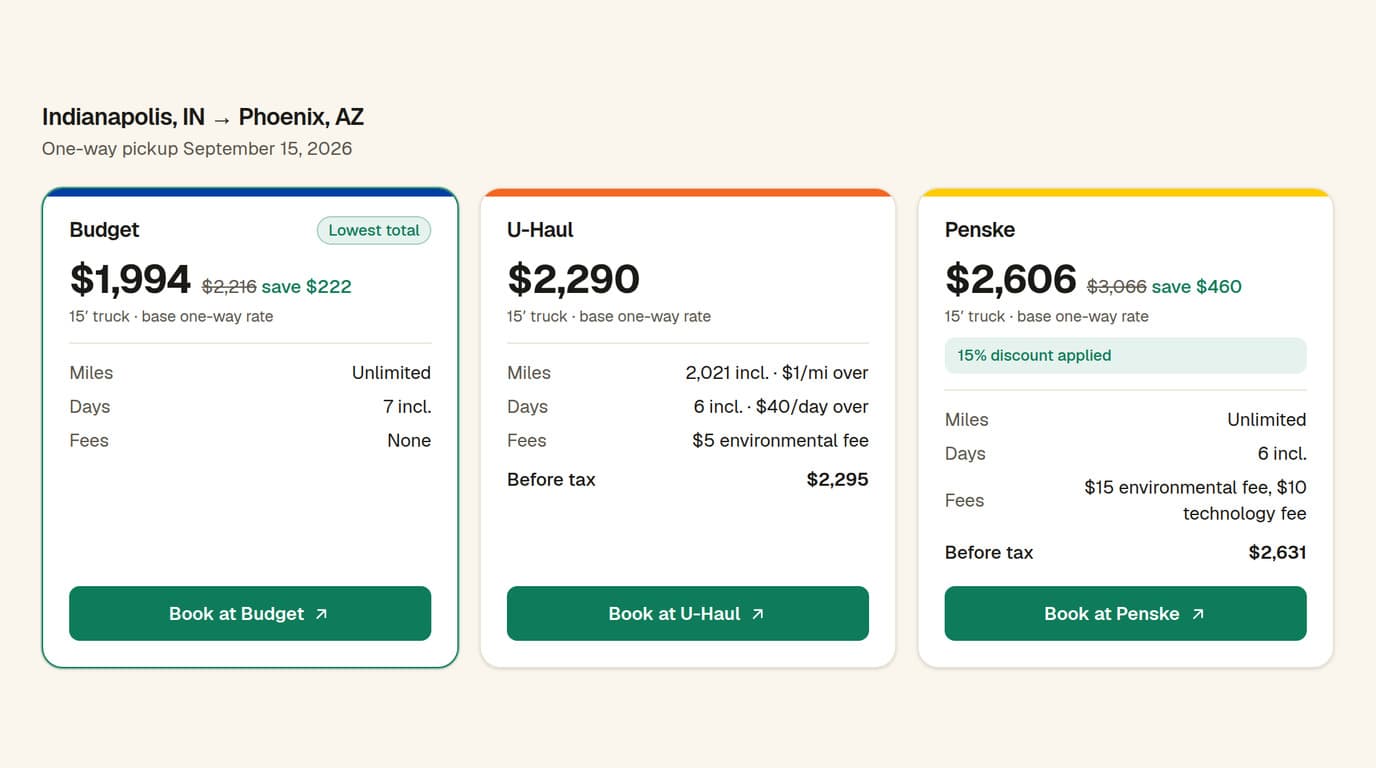
- Prices vary by company for the identical trip. In our own price checks, Budget is often the lowest and Penske often the highest, with U-Haul in the middle. That's a tendency, not a guarantee. Always check all three.
Everything below explains where those numbers come from.
The two pricing models
Before any dollar figures make sense, you have to know which of two completely different pricing models applies to your move.
A local, round-trip rental (pick up and return the truck at the same place) is priced like this:
daily rate + (miles driven × per-mile rate) + fuel + add-ons
The daily rate is deliberately low, often around $20–$40 per day for a mid-size truck. What gets you is the per-mile charge, which typically runs around $0.80–$1.20 per mile and applies to every mile you drive, including the round trips back and forth. A move across town might only be 30–50 miles, so the mileage stays modest. But it adds up faster than people expect.
A one-way rental (pick up in your old city, drop off near your new one) is priced completely differently:
one flat rate that already bundles a set number of days and the miles for your route
There's no per-mile meter running on a standard one-way rental; the mileage is baked in. Instead you get a single quoted price for the whole trip. That's simpler, but it's also the number that swings the most, for reasons we'll get to. Not sure which model fits your move? Our guide on one-way vs. round-trip rentals walks through the trade-offs.
What actually drives the price
Here are the levers that move your total, roughly in order of impact.
| Cost driver | Effect on price | Notes |
|---|---|---|
| Distance | Biggest single factor on one-way moves | Cross-country costs many times what a cross-town move does |
| Truck size | Moderate | Each size up adds to the daily or flat rate |
| Pricing model | Large | Local per-mile vs. one-way flat rate are entirely different math |
| Dates & season | Large on one-way | Summer, weekends, and month-end cost the most |
| Fuel | Large on long moves | 8–12 mpg means gas is a real budget line |
| Insurance / waiver | Moderate | Often $15–$30+ per day for a damage waiver |
| Equipment & fees | Small to moderate | Dollies, blankets, environmental fee, deposits |
Distance is the headline number, especially one-way. A 40-mile local move and a 2,500-mile cross-country haul aren't in the same universe, cost-wise.
Truck size matters, but less than people fear. Each step up adds to the base rate, usually by a modest amount. Renting one size too small (and making a second trip or leaving things behind) costs far more than the next size up would have. (Our size guide covers how to pick.)
Dates and season can swing a one-way quote by hundreds of dollars, which is worth its own section below.
Why one-way prices swing so much
Here's the part that confuses almost everyone: for the exact same truck, route, and date, one-way quotes can differ dramatically, both between companies and week to week from the same company. The reason is fleet imbalance.
One-way trucks are a finite pool constantly moving around the country, and rental companies want them spread where demand is. If a lot of people are leaving your city, trucks there are scarce and prices go up. If the company is short on trucks in your destination and wants more sent that way, they'll discount the route to get one there. So a truck from a high-outflow metro to a high-demand one is expensive; the same truck going the opposite direction can be cheap.
This imbalance shifts constantly, which is why the same search returns different prices on different days, and why the "lowest" company isn't always the same one. The practical move: check all three one-way companies for your route and date, every time.
That's also where the company tendencies come in. Across our own price checks, Budget frequently comes in lowest and Penske frequently highest, with U-Haul landing in the middle. Treat that as a rough tendency, not a rule. The fleet-imbalance effect can flip it on any given route, and the gap between them can be hundreds of dollars. Our side-by-side comparison shows how the three stack up.
Dates, season, and demand
When you move affects the price nearly as much as how far.
- Summer (roughly May through September) is peak moving season, and one-way rates rise with demand.
- Weekends cost more and book up faster than weekdays.
- The first and last few days of the month are the busiest of all, because leases turn over then.
If your dates have any give, a midweek, mid-month move in the off-season is both cheaper and easier to book. The difference isn't trivial. It can be the difference between a truck being available at all. Our guide on the best time to rent digs into the seasonal swings.
Don't forget the fuel
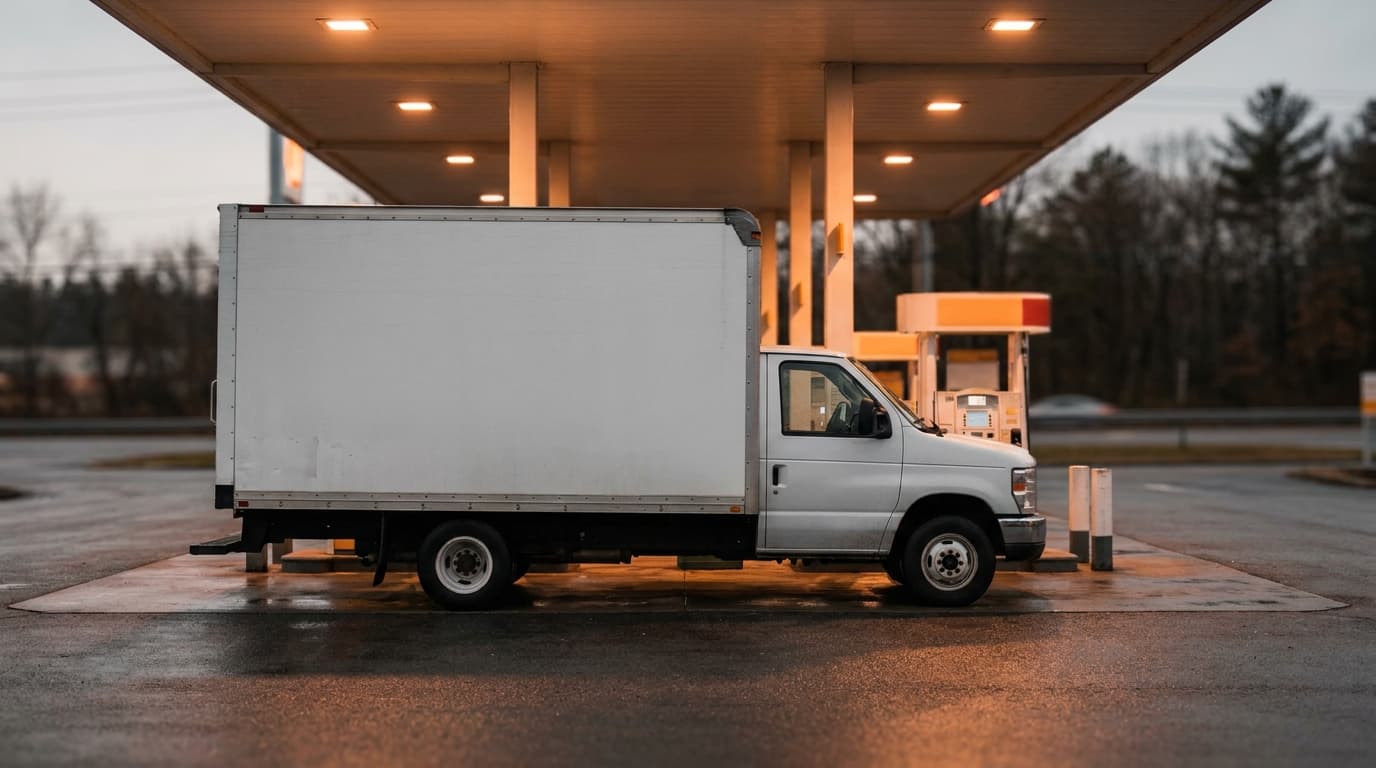
Fuel is the cost people most reliably underestimate. Moving trucks are heavy, boxy, and thirsty: a box truck gets somewhere in the neighborhood of 8–12 mpg, and a big 26-footer loaded to the roof sits at the low end of that.
Do the quick math on a long move. A 1,500-mile one-way trip at 10 mpg burns roughly 150 gallons. At $3.50 a gallon, that's about $525 in fuel alone, on top of the rental rate. Budget for fuel as its own line, not an afterthought.
One rule that saves real money: return the truck refueled to the level you picked it up at. If you don't, the company refuels it for you at a refueling surcharge: a per-gallon rate that is among the most expensive gas in America, often with a service fee stacked on top.
Insurance and protection add-ons
At the counter you'll be offered coverage, and here's the fact that catches people: your personal auto insurance and credit card usually do NOT cover a rental moving truck. Both are typically written for passenger cars and exclude box trucks.
That makes the rental company's own products often your only real coverage. A basic damage waiver commonly runs $15–$30+ per day, with additional options for cargo, personal injury, and more that can push protection to $30–$50+ per day if you add everything. It's a genuine cost to plan for. Just decide before you're standing at the counter under pressure. Our truck rental insurance guide explains what each product actually covers so you can walk in with an answer.
The fees hiding in the fine print
The advertised rate is the beginning, not the end. Watch for these:
- Environmental fee. A flat surcharge (often a few dollars to $10+) added to most rentals.
- Mileage overage. On a local rental, every mile past your estimate is billed at the per-mile rate. Go over and it adds up fast.
- Equipment rental. Furniture dollies, appliance dollies, and moving blankets/pads are not included by default and are billed per item or per day.
- Deposits and debit-card holds. Expect a hold on your card. Paying with a debit card often triggers a larger deposit and sometimes a credit check.
- Late / after-hours return fees. Return late and you can be charged a whole extra day. After-hours or wrong-location drop-offs can carry their own fees.
- Refueling surcharge. As above, bring it back full to avoid it.
- One-way "too good to be true" rates. Before you celebrate a low one-way quote, confirm it includes enough days and miles for your actual route.
None of these are exotic; they're standard. The trick is expecting them so they're in your budget from the start.
The bottom line
There's no single sticker price for renting a moving truck. But there is a knowable range. A local move is usually a low daily rate plus roughly a dollar a mile plus fuel, landing in the low hundreds for most across-town moves. A one-way move is a single flat rate that can run from a few hundred dollars to $2,000–$3,000+ for a loaded cross-country haul, depending heavily on distance, dates, and which way the trucks are flowing that week. On top of either, budget for fuel (those 8–12 mpg add up), protection, equipment, and the standard fees above.
The single best way to control the total: compare all three one-way companies for your exact route and dates, book early, move mid-week and off-season if you can, and bring the truck back full and on time. For more tactics, see our guide on how to save on a truck rental.
Ready for a real number? Run your trip through the moving cost estimator, then compare U-Haul, Penske, and Budget side by side for your route.
Not sure which truck to book?
Answer two quick questions and get a size recommendation, plus a side-by-side of how U-Haul, Penske, and Budget stack up.