The Best Time to Rent a Moving Truck (to Save Money and Stress)
The same truck, same route, and same driver can cost wildly different amounts depending on when you move. Here's how season, day of week, day of month, and how far ahead you book each swing the price, and how to land on the cheap side of all four.
Here's something first-time movers rarely realize: the price of a moving truck isn't really about the truck. The same 16-footer, on the same route, with you at the wheel, can cost dramatically more or less depending on nothing but when you rent it. Truck rental runs on demand-based pricing over a finite fleet, which means timing is one of the few levers that's fully in your control.
If your moving date is flexible even by a week or two, that flexibility is worth real money. This guide breaks down the four timing dials that matter (season, day of week, day of month, and lead time) and shows you where the cheap, easy-to-book windows hide.
The short version
If you only read one section, read this. The cheapest, least stressful time to rent a moving truck is:
- Fall or winter, roughly October through April, rather than the summer peak.
- Mid-month, the second and third weeks, rather than the start or end.
- Midweek, Tuesday through Thursday, rather than a weekend.
- Booked well ahead, not scrambled together at the last minute.
The reverse of each (summer, month-end, weekends, and last-minute) is where prices climb and the truck you want sells out. Nail even two or three of these and you'll usually beat the person who moved a week earlier and never thought about timing.
Why timing moves the price at all
Two facts explain everything below.
First, prices are demand-based. Rental companies raise rates when lots of people want trucks and cut them when trucks sit idle. There's no fixed "sticker price." The quote you see reflects how busy your date and location are right now.
Second, the fleet is finite. There are only so many 26-foot trucks in any given city on any given morning. When demand spikes against that fixed supply, two things happen at once: prices go up and availability goes down. That's why the busy windows are a double hit. You pay more for a truck that's also harder to get.
Everything else in this guide is really just a map of when demand rises and falls.
By season: fall and winter beat summer
Season is the biggest single swing, and the pattern is consistent across the industry.
Summer is peak. Expect the highest prices and the tightest availability. Roughly May through September is moving season, and late May through August is the crest of it. Families move between school years, leases cluster around summer, and the weather cooperates. All of that demand lands on the same fixed fleet, so rates rise and popular sizes book out early.
Fall and winter are the bargain seasons. Once school is back and the holidays approach, demand falls off and prices soften. October through April is generally the cheapest and easiest stretch to rent, with the deepest lull in the coldest winter months. The trade-off is obvious: you may be moving in worse weather. But if saving money is the priority, an off-season move is the most effective single choice you can make.
If your date has any give, shifting a summer move into September or October can meaningfully cut the cost. For the full menu of savings tactics, see our guide on how to save on a moving truck rental.
By day of the week: midweek wins
Weekends are convenient, which is exactly the problem. Everyone wants them.
Most people move on Saturday or Sunday because they don't want to burn vacation days. That concentrates demand into two days, pushing weekend rates up and thinning out the available trucks. Friday rides along with the weekend and tends to be busy too.
Tuesday, Wednesday, and Thursday are the quiet, cheaper days. Midweek moves fight less competition for the same trucks, which usually means a better rate and far more choice of size and pickup location. If you can take a day off midweek, or you're moving on a flexible schedule anyway, this is close to free money.
Mondays sit in between: better than the weekend, not quite as calm as the true midweek days.
By day of the month: aim for the middle
This is the timing dial most people have never considered, and it's a big one.
Leases overwhelmingly begin on the 1st and end on the 31st, so move-outs and move-ins pile up at both ends of the month. The last few days and the first few days are the busiest stretch after summer weekends: high prices, scarce trucks, and long counter lines.
The middle of the month, roughly the 10th through the 20th, is the calm zone. Far fewer leases turn over then, so demand eases and both price and availability improve. A move on the 15th will almost always be cheaper and less stressful than the same move on the 31st or the 1st.
The nastiest scenario is stacking the busy signals on top of each other: a summer weekend at the end of the month is about as expensive and hard to book as truck rental gets. Break even one of those three and you're already ahead.
How far ahead should you book?
More lead time almost always means a better price and better availability. Booking early does two things for you:
- Locks in a rate before it climbs. As your date fills up, prices tend to rise. Reserving ahead captures the lower rate.
- Secures the truck itself. Popular sizes on popular dates genuinely sell out. The 26-foot truck and other large sizes are the first to go, and one-way trucks, which come from a limited, roaming pool, disappear fastest of all.
As a rough rule of thumb, book a few weeks ahead for a routine local move, and a month or more ahead for anything that lands on a peak date, needs a large truck, or is a one-way move. The tighter the supply of what you want, the more that head start matters.
And here's the reassuring part: most reservations cancel free. That makes booking early a low-risk move. Lock in a truck as soon as you have a date, then keep an eye on prices and re-check as the day nears. If a better rate appears, you can often rebook. You capture the early-booking availability without giving up flexibility. (Always confirm the specific cancellation terms when you reserve.)
The one-way wrinkle
Everything above applies to both local and long-distance rentals, but one-way moves have an extra timing quirk worth understanding.
One-way prices don't just track the calendar; they also track directional fleet imbalance between metros. Rental companies constantly need to reposition trucks to match where people are moving. When lots of people are leaving your city, trucks there are scarce and one-way rates out are high. When a company has a surplus of trucks piling up in your destination, it will discount trips heading there to rebalance.
That imbalance is often seasonal. Think of the classic "snowbird" flows: trucks stream toward the Sun Belt in winter and back north in spring. That can make the very same lane cheap in one direction and pricey in the other. So a one-way rate isn't only about when you move but which way you're going relative to everyone else.
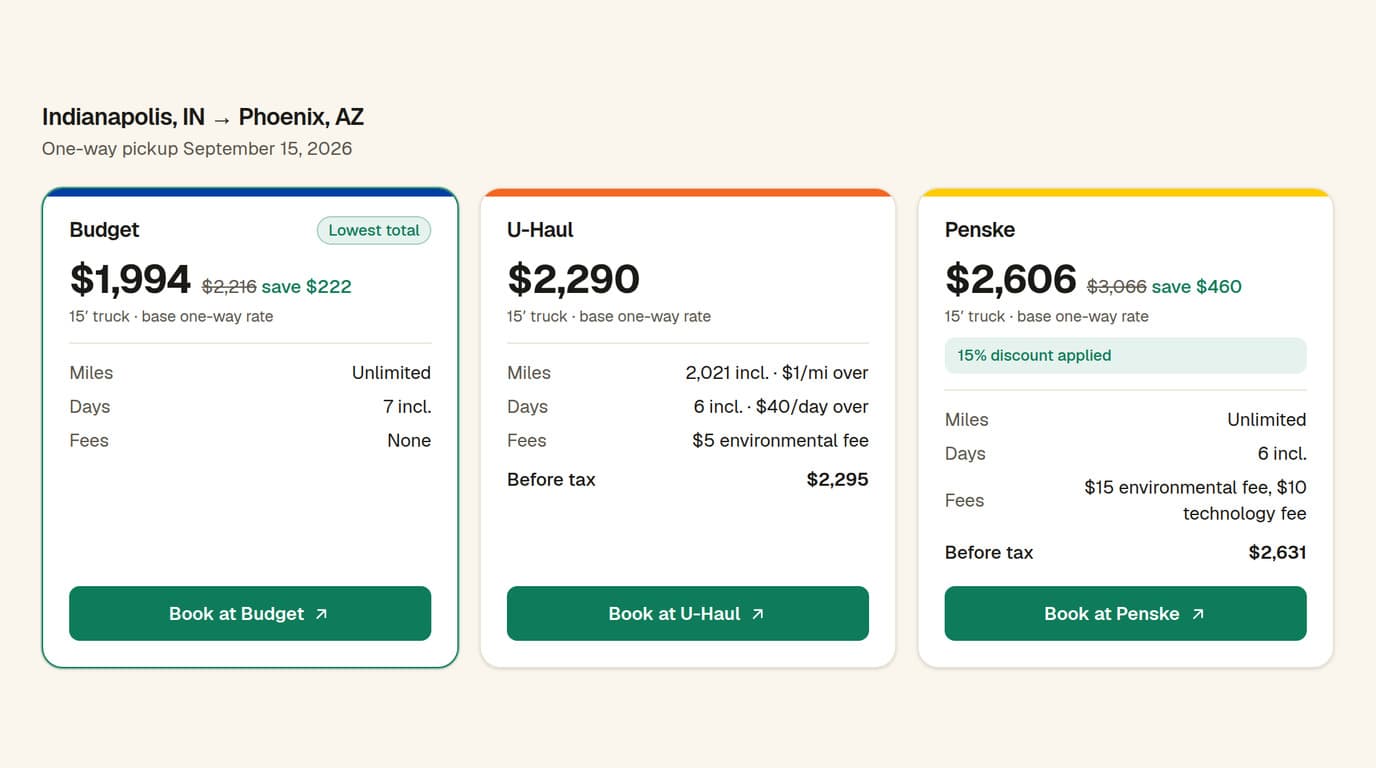
The practical takeaway: for a one-way move, check the price in your direction specifically, and don't assume it mirrors the return trip. Our guide on one-way vs. round-trip rentals covers the trade-offs, and our comparison page lets you see how U-Haul, Penske, and Budget quote your exact lane.
Cheapest vs. priciest times, at a glance
| Timing dial | Cheapest / easiest | Priciest / tightest |
|---|---|---|
| Season | Fall & winter (Oct–Apr) | Summer (late May–Aug) |
| Day of week | Tue–Thu | Fri–Sun |
| Day of month | Mid-month (10th–20th) | End & start of month |
| Lead time | Booked weeks ahead | Last-minute |
| One-way direction | The "surplus" direction | The "outflow" direction |
You won't always control every row. But every row you win pushes the price down and makes the truck easier to get.
The bottom line
The best time to rent a moving truck is an off-season, mid-month, midweek date that you booked well in advance. And if you're moving one-way, make it one that runs in a direction the fleet needs anyway. You rarely get to hit all of those, but each one you catch bends the price in your favor, because it all comes back to the same thing: demand against a finite fleet. Move when demand is low, and you pay less for a truck that's easier to reserve.
Ready to put it to work? Get a ballpark first with our moving cost estimator, read up on the full breakdown of what a truck rental costs, then compare U-Haul, Penske, and Budget for your date and route.
Not sure which truck to book?
Answer two quick questions and get a size recommendation, plus a side-by-side of how U-Haul, Penske, and Budget stack up.