13 Ways to Save on a Moving Truck Rental
A moving truck can cost a couple hundred dollars or well over a thousand for the same move. The difference is mostly choices you control. Here are 13 concrete ways to spend less without cutting the corners that matter.
The price of a moving truck isn't a fixed number handed down from above. For the exact same move (same size truck, same route, same weekend), two people can pay wildly different amounts, and the one who paid less almost never got lucky. They made a handful of decisions the other person didn't know to make.
This guide is those decisions. Thirteen concrete, honest ways to bring the cost down, roughly in order of how much they'll save you. None of them involve gambling with an under-sized truck or skipping coverage you actually need. Those "savings" have a way of turning into the most expensive part of the move.
The short version
If you only do four things, do these:
- Compare all three companies for your exact route. U-Haul, Penske, and Budget can quote hundreds of dollars apart for the same move. Checking one company is how you overpay.
- Move midweek and mid-month, in the off-season if you can. A Tuesday in October is far cheaper than a Saturday at the end of May.
- Book early. Availability tightens and last-minute rates climb, especially on one-way trucks.
- Size it right and refuel it yourself. Too small means a costly second trip; returning it low on gas triggers a brutal per-gallon surcharge.
Everything below expands on those, plus the smaller wins that add up.
Get the price right
1. Compare all three companies for your exact lane
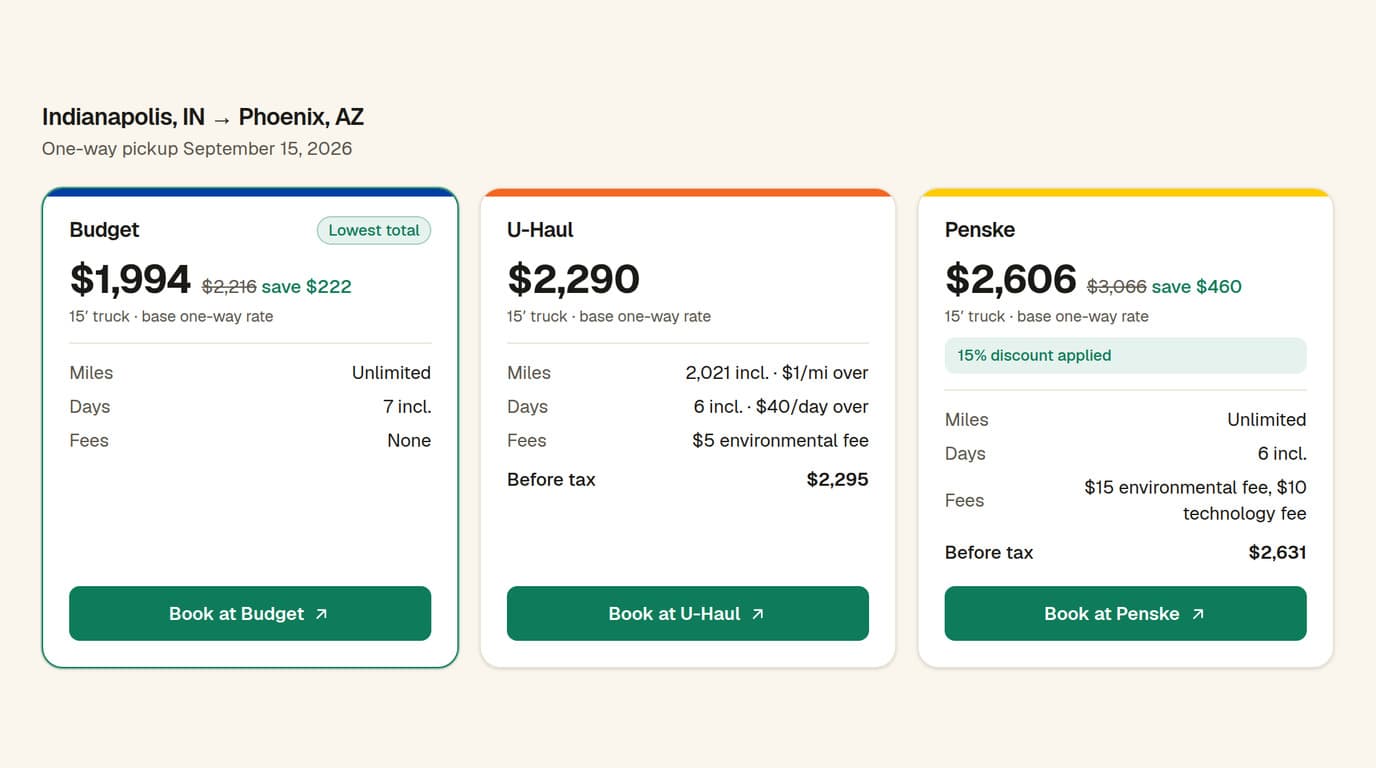
This is the single biggest lever, so it's first. Only three national companies rent moving trucks to consumers for one-way moves: U-Haul, Penske, and Budget Truck. For the same route and date, they routinely quote prices that differ by hundreds of dollars, because one-way pricing depends on how badly each company needs trucks moved in your direction, and that imbalance shifts week to week.
The mistake is checking one company, seeing a number, and booking. Always price all three for your pickup city, your drop-off city, and your dates. Our side-by-side comparison lines them up, and the moving cost estimator gives you a ballpark before you start quoting so you know whether a price is good or not.
2. Book early
Booking ahead helps two ways. First, price: last-minute rates are usually higher than the same reservation locked in weeks out. Second, availability: one-way trucks are a finite pool moving around the country, and the size you want, on the day you want, from a location near you, can genuinely sell out around month-end and during summer.
Because most reservations cancel free, there's almost no downside: reserve early to lock the rate, then re-check prices as your date nears and rebook if something drops.
3. Look for discount codes and programs, then ask
Discounts exist, but they're quiet. Many companies offer AAA, military and veteran, and student discounts. They're rarely advertised at the counter, so you have to ask directly whether your membership or status qualifies. Aggregator and coupon sites sometimes carry promo codes too, though they come and go, so treat any specific code as unverified until it actually applies at checkout.
A fair warning: a "10% off" banner on a company that quoted the highest base rate can still leave you paying more than a competitor's plain price. Stack discounts on top of the cheapest base quote from step 1. Never let a coupon talk you out of comparing.
Rather than ask you to do that by hand, our quote tool does it for you: it prices all three companies for your lane and tests the discounts you qualify for against each live quote, so only the ones that actually work show up.
Get the timing right
4. Move midweek instead of on a weekend
Weekends are when everyone moves, and demand sets the price. Shifting your move to a Tuesday, Wednesday, or Thursday is one of the easiest ways to pay less, and trucks are easier to reserve too. If your schedule has any give, a weekday is close to free money.
5. Move mid-month instead of at the ends
Leases turn over on the 1st and near the end of the month, so those dates are the busiest and priciest of any month. The middle of the month is calmer and cheaper. Combine it with a weekday and you've hit the two quietest dials at once.
6. Move in the off-season
Roughly May through September is peak moving season, with the summer weekends being the most expensive stretch of the year. If you can move in the fall or winter instead, rates ease across the board. You won't always have this flexibility, but when you do, it's real money. Our guide on the best time to rent a moving truck breaks down the seasonal, weekly, and monthly swings in detail.
7. Be flexible on your dates and let price decide
If tips 4 through 6 have a common thread, it's this: flexibility is worth cash. Rather than picking a date and accepting whatever it costs, try pricing a few candidate dates and letting the cheapest one win. Even shifting a Saturday move to the Thursday before can drop the quote noticeably. The estimator and comparison tools make it quick to test a few options side by side.
Get the truck right
8. Pick the right size, not the smallest
Renters instinctively book the smaller truck to save money, and it backfires more often than it works. Here's the asymmetry:
- Too big: you pay a modestly higher rate and part of the cargo area rides empty. Mildly wasteful.
- Too small: on a local move you make a second round trip, which means more miles, more fuel, more hours, maybe a second rental day. On a one-way move there is no second trip; you leave things behind or ship them separately.
The downside of too-small dwarfs the downside of too-big, so when you're genuinely between sizes, size up. It's cheap insurance, not a splurge. Our truck size guide matches homes to sizes room by room so you land on the right one the first time.
9. Pick one-way vs. round-trip correctly
These are two different products, and choosing wrong is expensive. A round-trip (local) rental, where you pick up and return to the same spot, is priced as a low daily rate plus a per-mile charge, and it's right for moves across town. A one-way rental, where you drop off near your new home and never drive the truck back, is a single flat rate that bundles the days and miles for your route.
The costly error is using a round-trip rental for a long-distance move to save on the flat rate, then paying in fuel, days, and mileage to drive the empty truck all the way home. For any move to a new city, one-way almost always wins. Our guide on one-way vs. round-trip rentals walks through the math.
10. Reserve equipment only if you'll actually use it
Furniture dollies, appliance dollies, and moving blankets are cheap add-ons, but they're only worth it if they leave the truck. If you're moving a studio with two friends, you may not need the pad package. If you're wrestling a fridge and a washer down stairs, an appliance dolly is worth every cent. Match the equipment to the job instead of accepting the default bundle, and skip what you'll never unwrap.
Get the extras right
11. Refuel the truck yourself
Rental companies will happily refuel the truck for you and charge a per-gallon rate that is one of the worst deals in America, often with a service fee stacked on top. Return the truck at the same fuel level you got it, and fill up at a normal gas station on the way in. Photograph the gauge at pickup and again at return so there's no dispute. This one takes ten minutes and routinely saves real money.
12. Return on time
A late drop-off can trigger a whole extra day's charge, not a prorated hour or two. Know your return deadline, build in a buffer, and if you're running behind, call the location. Sometimes they'll work with you, but only if you ask before the clock runs out. On a one-way rental, also confirm you have enough days built in for the drive so you're not paying for add-on days you could have bundled up front.
13. Decline add-ons you don't need, but don't skip coverage you do
Plenty of counter add-ons are easy to pass on. Coverage is the one to think hard about. Here's the fact people miss: your personal auto insurance and your credit card's rental coverage usually do NOT extend to a moving truck. Both are typically written for passenger cars, and box trucks are commonly excluded. So the rental company's damage waiver may be your only real protection.
Declining coverage to save a few dollars a day is a genuine gamble: one dent or fender-bender can cost more than the entire rental. Don't decide cold at the counter. Read our truck rental insurance guide, then call your own insurer and card issuer, so you walk in already knowing which coverage to buy and which to wave off.
One more trade-off worth weighing here: loading help versus a bigger truck. Hiring an hour or two of labor to load efficiently can occasionally let you fit a move into a smaller, cheaper truck, but only if the labor costs less than the size difference. Usually the roomier truck is the cheaper and less stressful answer; run the numbers rather than assuming help pays for itself.
The bottom line
Almost every dollar you save on a moving truck comes from four dials: which company, which date, which size, and which extras. Compare all three companies for your exact route, aim for a quiet weekday in the middle of an off-season month, book early, size the truck so you never need a second trip, refuel it yourself, and buy the coverage you need while skipping the add-ons you don't.
Do that and you'll land near the bottom of the price range for your move without cutting a single corner that matters. Start by getting a ballpark from the moving cost estimator, then compare U-Haul, Penske, and Budget for your route and dates. For the full picture of what drives the number, see our moving truck rental cost guide.
Not sure which truck to book?
Answer two quick questions and get a size recommendation, plus a side-by-side of how U-Haul, Penske, and Budget stack up.