Every Moving Truck Rental Fee, Explained
The advertised rate is never the final number. Here's every line item that can show up on a moving-truck bill: base rate, mileage, fuel, taxes, deposits, and the surprise fees. Plus which ones you can avoid and which you're simply stuck with.
You see one number in the ad ("$19.95 a day" or "$1,299 one-way"), and then the total at the counter is a different, bigger number. That gap isn't a scam; it's just a stack of separate line items that never make it into the headline price. Mileage, fuel, taxes, a coverage add-on, an environmental fee, a deposit hold you didn't expect.
Once you know what each line means, the bill stops being intimidating. This guide walks down a typical moving-truck invoice item by item, in plain English, and tells you honestly which fees you can dodge and which ones everybody pays.
The short version
If you only read one section, read this:
- The base rate (a daily rate on local rentals, a flat rate on one-way) is the one number in the ad. Everything below gets added to it.
- Mileage is where local rentals surprise people: you pay per mile driven. One-way rentals bundle in a mileage allowance instead.
- Fuel is a choice: refill it yourself, or let them refill it and pay a steep per-gallon surcharge plus a service charge.
- Small mandatory add-ons like an environmental / vehicle-license-recovery fee and taxes are unavoidable but usually modest.
- The big optional line is coverage (the damage waiver and its cousins). Optional, but skipping it can be a real risk.
- The rest are avoidable-by-behavior fees: late returns, extra days, extra miles, after-hours drops, cleaning, and cancellation/no-show charges. Do the move cleanly and none of them appear.
Want a full-move estimate instead of a fee glossary? Our moving cost estimator rolls these into a single ballpark, and our rental cost guide breaks down what a typical move actually runs.
The base rate
This is the number on the billboard, and it works differently depending on the kind of rental.
On a local (round-trip) rental, the base rate is a low daily rate, often advertised somewhere in the ballpark of $20–$40 a day for a smaller truck, more for larger ones. That daily rate is real, but it's deliberately incomplete: on a local rental it does not include the miles you drive (more on that next).
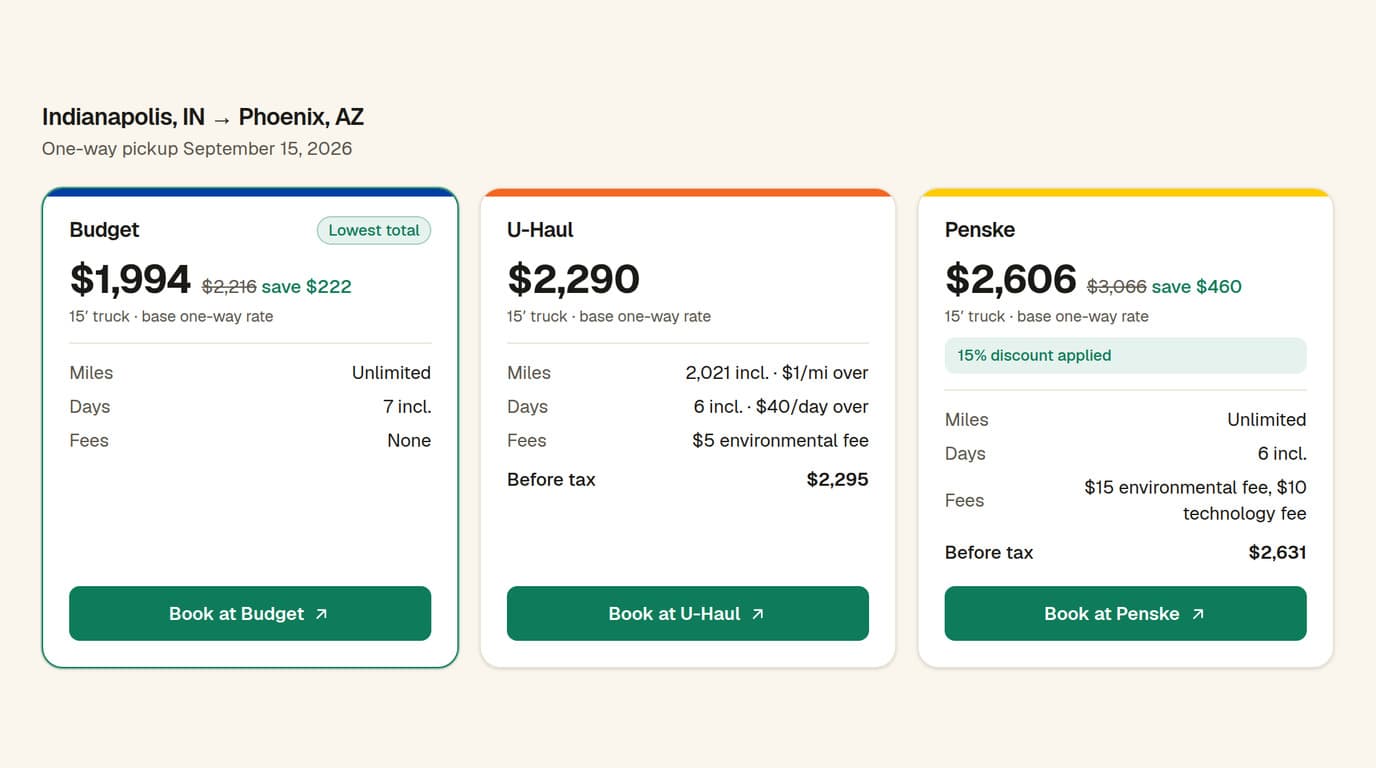
On a one-way rental, the base rate is a single flat rate that already bundles in a set number of days and a mileage allowance for your route. Because it's priced on supply and demand between your two cities, the same route can swing by hundreds of dollars week to week. There's no fixed number here. It depends entirely on where and when you're going.
Avoidable? No. The base rate is the cost of the truck. But it's the line most worth shopping around, since the three national one-way companies can quote very different flat rates for the identical route.
Mileage
This is the single most misunderstood line on a local bill.
On a local rental, mileage is charged per mile driven, commonly in the neighborhood of $0.79–$1.29 per mile, on top of that low daily rate. This is the catch behind those cheap "$19.95/day" ads: a 40-mile day of moving can add more in mileage than the base rate itself.
On a one-way rental, you instead get an included-mileage allowance: a set number of miles baked into the flat rate, sized roughly to your route with a little cushion. Stay inside it and mileage costs you nothing extra. Go over, and you'll pay a per-mile overage (often around $0.40 or more per additional mile).
Avoidable? Partly. You can't avoid paying for miles you drive on a local rental, but you can avoid overage by estimating your route honestly and not taking the long way. Our savings guide has tactics for keeping mileage down.
Fuel
Rental trucks are handed over with a certain amount of gas in the tank, and you're expected to bring them back at the same level. How you handle fuel is entirely your choice, and it's one of the easiest places to waste money.
Option one: refuel the truck yourself right before you return it, back to where the needle started. Cheap, simple, done.
Option two: bring it back low and let the company top it off. Now you pay the fuel surcharge, a per-gallon rate that is typically well above the pump price, sometimes with a flat refueling service charge stacked on top. It is one of the worst per-gallon deals you'll ever be offered.
Some companies also sell a prepaid "EZ-Fuel" style option where you pay upfront for a tank and skip the return-trip gas station. You only come out ahead if you actually run the tank down.
Avoidable? Yes. Fill the tank yourself and photograph the gauge at return. The fuel surcharge is 100% avoidable with one stop at a gas station.
The environmental / vehicle-license-recovery fee
Look near the bottom of the bill and you'll usually find a small line called something like an environmental fee, vehicle license recovery fee, or registration recovery fee. This is the company passing along its own costs of licensing, registering, and disposing of fluids across a big fleet.
It's typically a modest flat amount per rental (think single digits to low double digits of dollars), and it shows up on most rentals regardless of who you book with.
Avoidable? No. It's a standard pass-through fee. It's small, but it's not optional.
Coverage and the damage waiver
At the counter you'll be asked whether you want to add protection, and this is the biggest optional number on the whole bill.
The core product is a damage waiver (often branded as a collision or physical-damage waiver): pay a daily amount and the company agrees not to charge you if the truck is damaged. Layered on top are optional add-ons: coverage for the cargo you're hauling, personal accident and medical coverage, and supplemental liability for damage to others.
The reason this matters: your personal auto insurance and your credit card's rental coverage usually do NOT extend to a moving truck. Both are typically written for passenger cars, and box trucks are commonly excluded, so the company's waiver is often your only realistic coverage.
Avoidable? Technically yes, since it's optional, but skipping it can leave you personally on the hook for a damaged truck. Don't decide cold at the counter. Read our truck rental insurance guide and check with your own insurer first, so you walk in already knowing your answer.
Equipment rental
Trucks come empty. Anything that helps you move the load is a separate rental:
- Furniture dolly and appliance/hand truck: usually a few dollars each per rental.
- Furniture pads / moving blankets: often sold in bundles for a flat charge.
- Utility straps and towing gear: priced per item.
These are genuinely useful (renting a dolly is almost always cheaper than a thrown-out back), but they're add-ons charged per item.
Avoidable? Yes. Bring your own dolly and blankets, or decline what you don't need. Just don't skip a dolly for heavy furniture to save a few dollars.
Taxes
Like almost any transaction, truck rentals are subject to sales tax, and some cities and states add their own rental or vehicle taxes on top. Taxes are applied to the taxable portion of your bill, so a bigger rental means a bigger tax line.
Avoidable? No. Taxes are set by your state and city, not the rental company.
The deposit / hold
When you pick up the truck, the company places a hold on your card to cover potential charges: extra miles, fuel, damage. It's not an extra fee; it's a temporary authorization that's released after you return the truck and the final bill settles.
The catch is the payment method: paying with a debit card usually triggers a larger hold (and sometimes extra ID requirements), because the company can't rely on a credit line. That ties up real money in your checking account for the length of the rental plus a few days. A credit card generally means a smaller hold.
Avoidable? The hold itself isn't avoidable, but you can minimize it, and avoid a drained checking account, by paying with a credit card instead of a debit card.
The behavior fees: late, extra-day, after-hours, and cleaning
This group is entirely within your control. None of them appear if the return goes smoothly.
- Extra-day charge: keep the truck past your rental period and you're billed for additional full days at the daily rate.
- Late fee: return after your due time and you can trigger a late charge, sometimes a full extra day even if you're only a few hours over.
- Extra-mile charge: exceed your one-way mileage allowance and each extra mile is billed at the overage rate.
- After-hours / drop-off fee: return the truck outside operating hours or use a self-service drop where it isn't included, and some locations tack on a convenience fee.
- Cleaning fee: hand it back with trash in the cab, debris in the cargo box, or spills, and you can be charged a cleaning fee. Sweep it out and pull your trash.
Avoidable? Yes, all of them. Return on time, on the agreed route, swept out, at a staffed location during hours. Our return guide walks through a clean handoff.
Cancellation and no-show fees
Most reservations can be cancelled free if you give enough notice, which is exactly why booking early carries little downside. But cancel at the last minute, or simply never show up, and some companies charge a cancellation or no-show fee. Policies vary by company and by how far ahead you cancel.
Avoidable? Yes. Cancel within the free window, or keep the reservation. Know the specific policy before you book.
Which fees you can actually avoid
Here's the whole bill, sorted by whether you can dodge it:
| Fee | Typically avoidable? |
|---|---|
| Base rate (daily or flat one-way) | No, but shop all three companies |
| Per-mile charge (local) | No, you pay for miles driven |
| Mileage overage (one-way) | Yes, estimate your route honestly |
| Fuel surcharge | Yes, refuel it yourself |
| Environmental / license-recovery fee | No, small pass-through |
| Damage waiver & coverage add-ons | Optional, but risky to skip |
| Equipment (dolly, blankets, straps) | Yes, decline or bring your own |
| Sales / rental taxes | No, set by your city and state |
| Deposit / hold | No, but smaller with a credit card |
| Extra-day charge | Yes, return on time |
| Late fee | Yes, return by your due time |
| After-hours / drop-off fee | Yes, return during staffed hours |
| Cleaning fee | Yes, sweep it out |
| Cancellation / no-show fee | Yes, cancel within the free window |
The bottom line
A moving-truck bill looks scary until you separate it into the three groups it really is: the base rate you're always going to pay, the small mandatory add-ons (environmental fee, taxes, the hold) that are minor and non-negotiable, and the avoidable fees (fuel, equipment, late, cleaning, overage) that only show up if you let them. The single most expensive avoidable line is almost always fuel, and it takes one gas-station stop to erase.
Know the line items before you get to the counter and nothing on the invoice will surprise you. Ready to put real numbers to it? Run your move through the moving cost estimator, then read the full rental cost breakdown to see where your money goes.
Not sure which truck to book?
Answer two quick questions and get a size recommendation, plus a side-by-side of how U-Haul, Penske, and Budget stack up.