How to Return a Moving Truck (Without the Extra Fees)
The return is where the surprise charges live: wrong location, late clock, empty gas tank, dirty cargo box. Here's how to hand back the keys clean, on time, and with proof, so your final bill matches the quote you booked.
You did the hard part. The truck is unloaded, the new place is a maze of boxes, and all that's left is to bring the truck back. It feels like the easy step, but the return is exactly where the avoidable fees hide. Bring it to the wrong lot, drop it an hour late, or leave the tank half-full, and the tidy price you booked can balloon by a couple hundred dollars.
The good news: every one of those charges is preventable, and none takes more than a few minutes to sidestep. The right place, the right time, the right fuel level, and the photos that protect you if the company sees it differently.
The short version
If you only read one section, read this. A clean, fee-free return comes down to six things:
- Return to the exact right location. One-way? It's the specific drop-off assigned to your reservation, not just any branch in town. Local? It's the same place you picked up.
- Get it back on time. A late return can trigger a whole extra day's rate, not a small hourly fee.
- Refuel to the level you started at, and keep the receipt. The company's refueling surcharge is one of the worst per-gallon deals around.
- Sweep out the cargo box and pull everything of yours, and don't forget rented blankets and dollies. A dirty or non-empty truck invites a cleaning fee.
- Do a walkaround and photograph everything as your proof: fuel gauge, odometer, the empty swept box, and any damage.
- Get a receipt or confirmation email, then check the final charges for anything that looks off.
Everything below is just these six things in detail.
Return it to the right place
This is the one that can cost the most, and the one people don't see coming.
If you did a one-way rental, your contract names a specific drop-off location near your destination, the only place you can return the truck without a problem. Not "the nearest U-Haul" or "any Penske lot," but the one on your paperwork. Companies route their trucks based on where they need equipment next, so dropping elsewhere can trigger a hefty wrong-destination or re-delivery fee, sometimes hundreds of dollars. If the assigned lot is inconvenient, call the company before your move and get any change confirmed in writing. Don't improvise on drop-off day.
If you did a local (round-trip) rental, it's simpler: you return to the same location you picked up from. Bring it back anywhere else and you're into the same wrong-location territory.
Either way, note the return lot's hours before you go. Some are dealer or franchise sites with limited hours, and a locked gate is how an on-time return quietly becomes a late one. We cover how the drop-off gets assigned in our step-by-step rental guide.
Return it on time
Truck rentals don't work like a hotel checkout with a grace period. Your contract lists a return date and time, and blowing past it doesn't usually mean a small hourly charge. It commonly means another full day's rental rate, plus potentially another day of any protection product you added.
A few habits keep you clear:
- Know your exact due time, not just the date. "Due Saturday" and "due Saturday at 9 a.m." are different deadlines.
- Build in a buffer. Traffic, a slow unload, and refueling all eat time. Aim to be at the lot well ahead of the clock.
- If you're going to be late, call. The company can often extend your reservation for an added day at the normal rate. That's far better than an unplanned penalty, and it keeps you from being flagged as an overdue truck.
Our moving truck fees explained guide breaks down the whole menu of charges.
Refuel to where you started
Nearly every rental runs on a "return it as you got it" fuel policy: whatever the gauge read at pickup is where it needs to read at return, which is why the pickup photo of the gauge matters so much.
Here's the part that stings: if you bring it back low, the company refuels it for you, and their per-gallon surcharge is priced painfully, typically well above pump price, often with a service fee on top. It's almost always the most expensive gas you'll never enjoy. So:
- Top off at a gas station near the return lot on your way in, matching the gauge to the pickup level.
- Keep the fuel receipt. If the company later claims the tank was low, a timestamped receipt from a station a mile from the lot is powerful evidence.
- Photograph the gauge once you've parked, ignition on, so the needle position is unmistakable.
Don't overfill past your starting level either. You won't be reimbursed for gas you leave behind. Match the line.
Sweep it out and take everything
The cargo box is supposed to come back empty and broom-clean. Leave it dirty (packing debris, tape, a forgotten box) and you can be hit with a cleaning fee, plus a disposal charge for anything left behind.
Before you close the door for the last time:
- Sweep the cargo area. A cheap broom, or even a good sweep with a piece of cardboard, clears the usual moving-day grit.
- Walk the whole box and the cab. Check the corners, wheel wells, glovebox, door pockets, and under the seats. Phone chargers, paperwork, and the last small box get left behind constantly.
- Return every rented accessory. Furniture pads and blankets, hand trucks and dollies, straps: anything you rented is counted at return, and a missing bundle or dolly gets billed at replacement cost.
Our unloading guide has tips for keeping the box tidy as you empty it, which makes this final sweep almost nothing.
Do a return walkaround and photograph everything
At pickup you photographed the truck to protect yourself from being blamed for old damage. Do the same in reverse at return. This five-minute habit is your entire defense if a charge shows up later.
Circle the truck and capture, clearly and with the timestamp on:
- The fuel gauge (ignition on), showing you matched the starting level.
- The odometer, documenting final mileage. This matters on local rentals billed per mile.
- The empty, swept cargo box, door up, showing nothing's left inside.
- The full exterior (every side, the roof line, and any pre-existing dents) so no new damage can be pinned on you.
- Any actual damage, if something did happen, photographed honestly. If you carried the damage waiver or other protection, documenting it properly is how you make that coverage work.
Save these somewhere safe. A dispute can surface days later, long after the truck has been rented to someone else.
Get your proof of return
The return isn't finished when you park. It's finished when the company acknowledges the truck is back and closed out. If a staff member inspects the truck with you, have them confirm the fuel level, mileage, and condition on the spot, and get a printed or emailed receipt showing the final charges. Read it before you leave the lot. This is your best chance to correct a fuel or cleaning charge while someone's standing right there. If you can, complete the return in the company's app too, for a time-stamped record on their side.
The after-hours key drop
Plenty of returns happen after the lot has closed, through a key-drop box. It's convenient, but it comes with a catch: no one inspects the truck with you, so if a charge appears, it's your photos against their word.
That makes documentation everything. For an after-hours return:
- Photograph and video the whole thing before you drop the key. Fuel gauge, odometer, swept empty box, every exterior panel, and the truck parked legally. A short walkaround video beats stills.
- Note the exact date and time you dropped the key, and where you parked.
- Follow the after-hours instructions exactly. Some want you to complete the return in the app and drop the key in a specific box. Skipping the app step can leave the truck showing as "not returned," which risks a late charge for a truck that's sat in their lot all night.
- Confirm you got a return confirmation by email or in the app within a day. If it doesn't come, call.
Avoid these return fees
A quick, scannable list of what actually shows up on inflated final bills, and the one-line fix for each:
- Wrong-location / re-delivery fee. Return to the exact assigned drop-off (one-way) or your original pickup lot (local). Confirm any change in writing beforehand.
- Extra-day charge for a late return. Know your exact due time, build a buffer, and call ahead if you'll run over.
- Refueling surcharge. Top off to the starting level near the lot and keep the receipt.
- Cleaning / disposal fee. Sweep the box and remove every last item.
- Missing-equipment charge. Return all blankets, pads, dollies, and straps you rented.
- Damage charge you didn't cause. Walkaround photos and video at return, exterior included.
- "Truck not returned" late fee after a key drop. Complete the return in the app and confirm you got a receipt.
Review your final charges
A day or two after you return, your final receipt lands. Read it, don't just archive the email. Compare it against your original quote and your photos, and look specifically for a fuel charge (you refueled, and you have the receipt), a cleaning fee (you swept, and you have the photo), an extra day (you were on time, so check the timestamps), a damage charge (your walkaround shows the real condition), or an equipment charge for something you returned. On a local rental, check mileage overages against your odometer photos too.
If something looks off, you have the receipts and photos to back you up. Contact the company promptly, calmly, and with your evidence attached. The sooner you flag it, the easier it is to resolve. This is exactly why those five minutes of photos are worth it.
The bottom line
Returning a moving truck is genuinely easy once you know where the fees live: the right location, on time, refueled to the line, swept clean, emptied of your stuff and their equipment, photographed, and confirmed with a receipt. Do those things and your final bill will match the price you booked. No surprises, no clawing back a charge weeks later.
Give yourself a buffer on return day, take the photos even when it feels like overkill, and read the final receipt when it arrives. Keep every step of your move on track with our free moving checklist, and if you're mapping out the whole rental from scratch, start with how to rent a moving truck.
Not sure which truck to book?
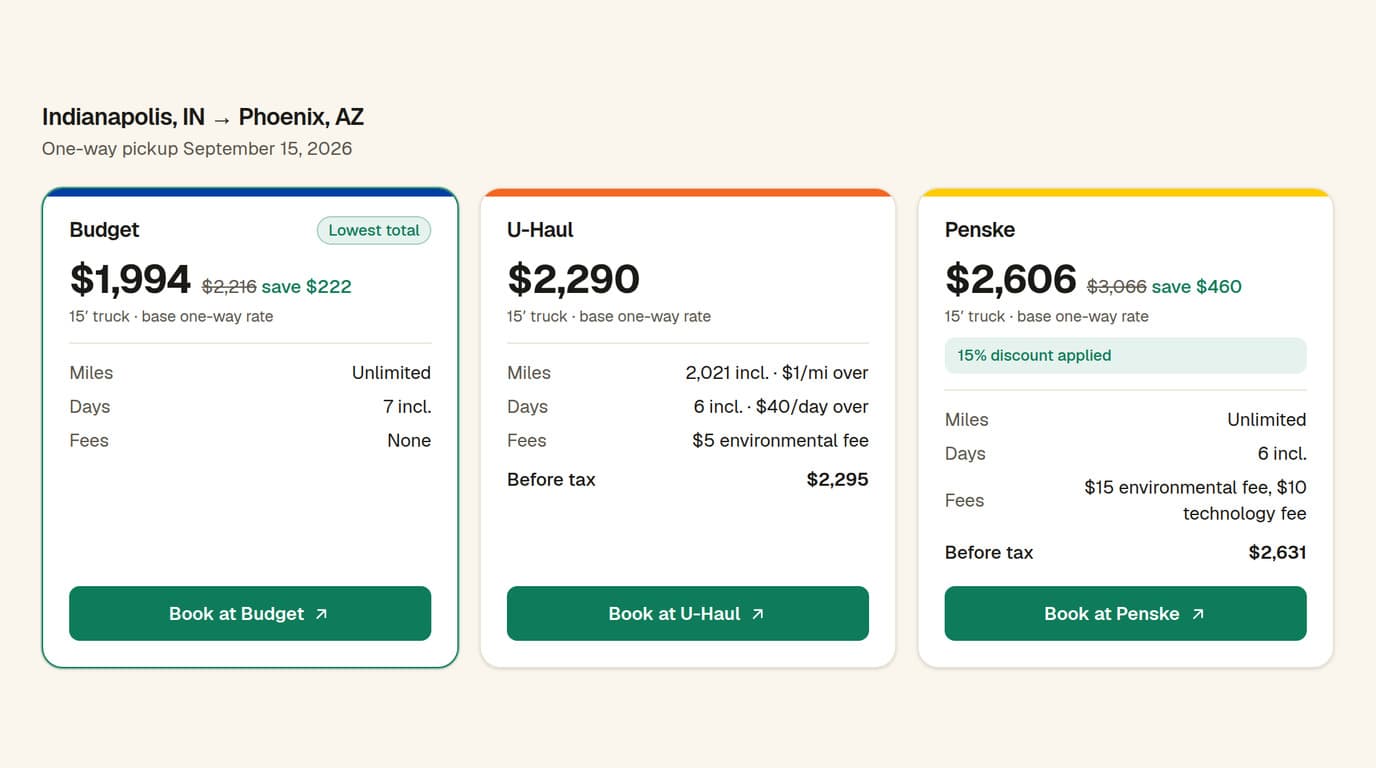
Answer two quick questions and get a size recommendation, plus a side-by-side of how U-Haul, Penske, and Budget stack up.