Your 8-Week Moving Timeline (Truck Rental Edition)
A calm, week-by-week countdown that builds your whole move around the one deadline that matters most: reserving the right truck early. Do that and nothing important gets left until the night before.

A move rarely goes wrong because of one big disaster. It goes wrong because a dozen small things all come due in the last 48 hours. The truck you meant to book is gone, the utilities never got scheduled, and you're taping boxes at midnight. The fix is boring but reliable: spread the work over eight weeks so each task lands with room to spare.
This guide lays out that countdown, with the truck rental as the anchor. Everything else hangs off the date you pick up the keys. Follow it week by week and moving day becomes just another item on a list you've already mostly finished.
The short version
If you only skim one section, here it is. Eight weeks out, the plan looks like this:
- 8 weeks out: Declutter, research and compare truck companies, set a budget, and measure your biggest furniture.
- 6 weeks out: Reserve the truck. This is the deadline everything else protects. Start gathering supplies and notify your landlord or schools.
- 4 weeks out: Pack non-essentials, line up help or loading labor, file your change of address, and schedule utility transfers.
- 2 weeks out: Confirm the reservation, pack most rooms, and plan your driving route.
- 1 week out: Confirm the exact pickup time and what to bring, pack almost everything, and build a first-day essentials box.
- Moving day: Do the pickup walkaround, load heavy items first, and drive calmly.
- Just after: Return the truck refueled and on time, then unpack at your own pace.
Want to actually check these off as you go? Our interactive moving checklist turns this whole timeline into a tool you can track from any device.
8 weeks out: decide and declutter
The best moving-day money is saved two months ahead, before you've packed a single box.
Purge first. Every item you get rid of now is one you don't pack, carry, or pay to move. Go room by room and be honest about what earns its spot in the truck. Fewer belongings can mean a smaller, cheaper truck and a shorter loading day. The declutter pays for itself twice.
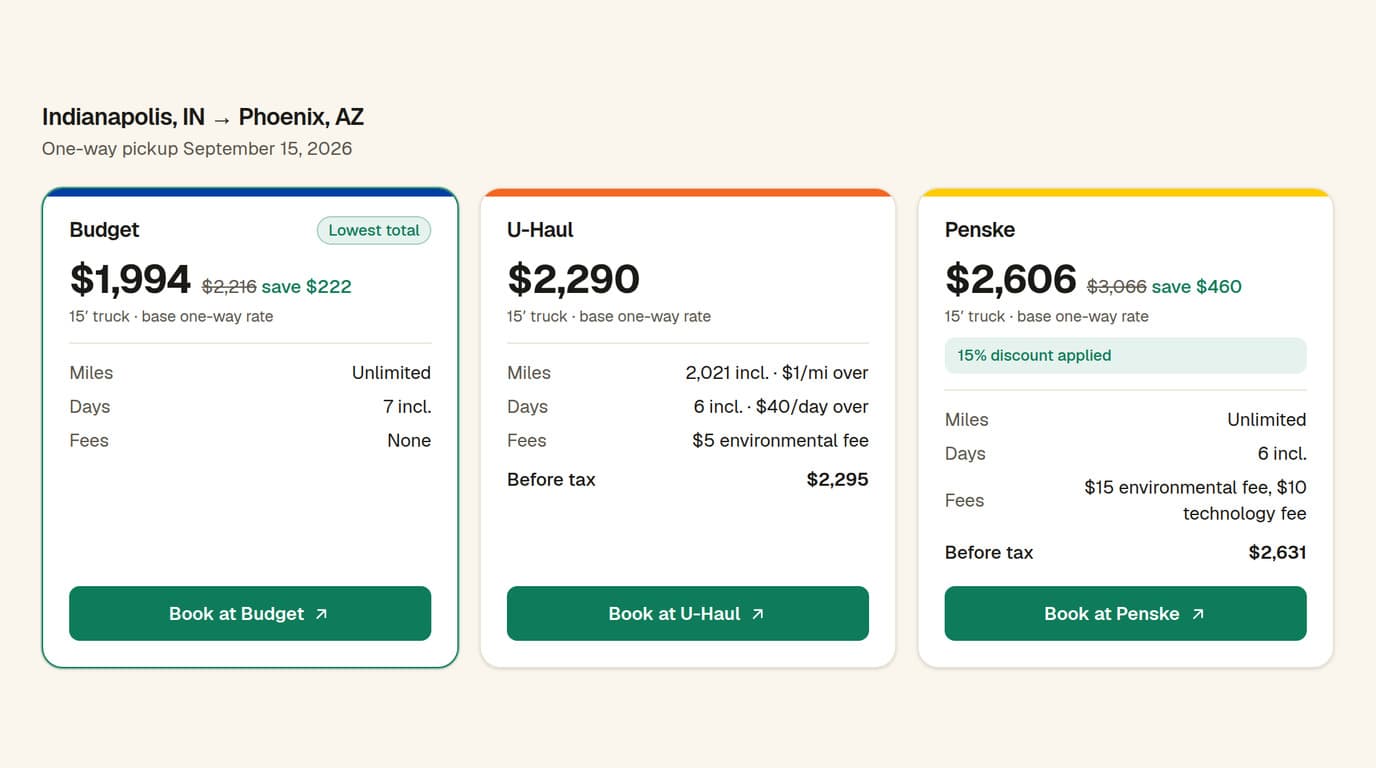
Research and compare companies. This is the moment to learn the landscape while you have no time pressure. For a move to a new city, only a few national companies rent one-way trucks to consumers, and their quotes for the same route can differ by hundreds of dollars. Read our step-by-step guide to renting a moving truck so you walk into the booking knowing what one-way versus round-trip means and which questions to ask.
Set a budget. Add up the truck rate, mileage or fuel, any protection product, plus pads, a dolly, and supplies. Knowing your ceiling now keeps the later decisions simple.
Measure your big furniture. Note the dimensions of your bed, couch, dresser, dining table, and largest appliance. Those measurements drive your truck-size choice and warn you early about anything that won't fit through a doorway or stairwell.
6 weeks out: reserve the truck
This is the week the whole timeline is built around. Book the truck now.
One-way trucks are a finite pool moving around the country, and the specific size you want (leaving your town, on your date) can genuinely sell out. Peak windows are the worst: the end and start of any month (leases turn over then), weekends, and the summer moving season. If your move is one-way or lands on a busy date, six weeks is not too early. Our guide on the best time to rent a moving truck shows exactly which dates to avoid and where the savings hide.
Booking early does two things at once: it locks in availability, and it usually locks in a better rate than a last-minute scramble. Most reservations cancel free, so there's little downside to reserving now and re-checking prices as your date nears.
With the truck handled, start the slow-burn tasks:
- Gather supplies. Boxes, tape, markers, and pads accumulate faster than you'd think. Start a corner of a room as your staging area. Our moving supplies checklist covers exactly what to buy and roughly how much.
- Notify the people who need lead time. Give your landlord written notice per your lease, and tell your kids' schools so records can transfer without a scramble.
4 weeks out: pack ahead and set up services
A month out, the goal is to get the boring logistics off your plate and start packing the things you won't miss.
Begin packing non-essentials. Off-season clothes, books, spare linens, decor, the good dishes. Anything you can live without for a month. Label every box with its room and a one-line list of contents. Boxes packed calmly now are boxes you're not throwing together in a panic later.
Line up your help. Confirm the friends who promised to lift, or book loading labor if you'd rather hire it. Either way, pin down the day and time now while people's calendars are open.
File your change of address. Redirect your mail through the postal service, and update your bank, employer, insurer, and any subscriptions.
Schedule utility transfers. Set electricity, gas, water, and internet to shut off at the old place and turn on at the new one, ideally the day before you arrive, so you're not unloading in the dark.
2 weeks out: confirm and pack the house
Two weeks out, the move stops being abstract.
Confirm the reservation. Call or log in to verify your truck size, pickup location, date, and pickup window are exactly what you booked. Catching a mix-up now is easy; catching it at the counter on moving day is not.
Pack most rooms. By the end of this week, everything except daily essentials and the kitchen should be boxed and labeled. Keep a running count of boxes so nothing wanders off.
Plan your route. For a local move, just note the best path and any low bridges or tight streets for a tall truck. For a long-distance move, map the whole drive, plan realistic daily mileage, and book any overnight stops now. A loaded truck is slower than your car, and you don't want to be hunting for a room at 10 p.m. with your life in the cargo box.
1 week out: final confirmations and the essentials box
The last week is about tightening every loose end so moving day runs on autopilot.
Confirm the pickup details. Reconfirm the exact pickup time and ask what to bring. That's typically your driver's license and the credit card on the reservation. Know the truck's return time and location too.
Pack almost everything. Leave out only what you'll use in the next few days. Strip beds last, and keep tools handy for disassembling furniture.
Build a first-day essentials box. This is the box that saves your sanity: a change of clothes, toiletries, phone chargers, medications, basic tools, snacks, paper towels, toilet paper, and anything you'll want within an hour of arriving. Load it last so it comes off first.
Make a refuel plan. Note where you'll fill up on return, and remember the golden rule: bring the truck back at the same fuel level you got it. The rental company's own refueling charge is one of the most expensive per-gallon deals around.
Moving day: pickup, load, and drive
You've done the planning. Today is mostly execution.
Do the pickup walkaround. Before you drive off, photograph any existing dents and scratches, note the exact fuel level, and test the roll-up door, the ramp, and all the lights. Five minutes here is your defense against a surprise damage charge.
Load heavy-first. Heaviest items (appliances, dressers, the couch) go in first, against the wall behind the cab, with weight balanced side to side. Strap loads to the anchor points so nothing shifts on the highway, and fill gaps with soft items. Our guide to loading a moving truck has the full playbook for a load that arrives in one piece.
Drive calmly. A loaded truck is taller, wider, heavier, and slower to stop than your car. Take turns wide, leave extra following distance, and watch your height at overpasses and drive-throughs. There's no prize for arriving early.
Just after: return it right, then unpack
Return the truck refueled and on time. The two fees people most often eat are the fuel charge and the late charge. A late drop can trigger a whole extra day. Refuel to your starting level, sweep out the cargo area, and photograph the empty truck and the fuel gauge as proof before you hand back the keys.
Then unpack at your pace. Start with that essentials box and the kitchen, make the beds, and let the rest come together over the following days. The hard part is already behind you.
The timeline at a glance
| When | Truck task | Everything else |
|---|---|---|
| 8 weeks | Research and compare companies; set a budget | Declutter; measure big furniture |
| 6 weeks | Reserve the truck | Gather supplies; notify landlord/schools |
| 4 weeks | — | Pack non-essentials; line up help; change of address; schedule utilities |
| 2 weeks | Confirm the reservation | Pack most rooms; plan the driving route |
| 1 week | Confirm pickup time and what to bring | Pack almost everything; build essentials box; refuel plan |
| Moving day | Pickup walkaround; load heavy-first; drive safely | Final sweep of the old place |
| Just after | Return refueled and on time | Unpack, starting with essentials |
The bottom line
A good move isn't about working harder in the final week. It's about starting eight weeks out and letting the truck reservation anchor everything else. Purge early, compare your options, book the truck at the six-week mark, and feed the rest of the tasks in a little at a time. Do that and moving day is the easy part.
Ready to make it real? Open the interactive moving checklist to track every step from here, and skim how to rent a moving truck before you lock in that six-week reservation.
Not sure which truck to book?
Answer two quick questions and get a size recommendation, plus a side-by-side of how U-Haul, Penske, and Budget stack up.