Cargo Van vs. Moving Truck: When the Van Is Enough
A cargo van is cheaper, easier to drive, and sips less gas than a box truck, but only if your load actually fits. Here's how to tell whether the van covers your move or whether you need to step up to the smallest truck.
Not every move needs a moving truck. If you're shifting a studio, a dorm room, or a modest one-bedroom, and especially if you're staying in town, a cargo van might do the whole job for less money, less gas, and a lot less white-knuckle driving. The trick is knowing where the van runs out of room, because that line is closer than most people think.
This guide lays out exactly what a cargo van holds, how it stacks up against the smallest box truck, and how to decide which one your move actually calls for.
The short version
If you only read one section, read this:
- A cargo van realistically holds a studio, a dorm, a lightly furnished small one-bedroom, or a few rooms' worth of boxes, roughly 245–300 cubic feet. It drives and parks like a big passenger van, costs the least to rent, and gets the best gas mileage of anything on the lot.
- The smallest box truck (a 10–12-footer) holds a genuine one-bedroom (real bed, couch, dresser, table) at roughly 380–450 cubic feet, and adds a taller ceiling and space over the cab.
- Choose the van when your load is small, a second trip is fine, parking is tight, and you want to save money and fuel.
- Choose the truck when you have real furniture, a full one-bedroom or more, or a one-way move where a second trip simply isn't possible.
Everything below is just this decision in detail.
What a cargo van actually holds
A cargo van is the smallest thing on a rental lot. Think of a large delivery van with the seats stripped out of the back. Behind the front seats you get an open box with somewhere around 245 to 300 cubic feet of space, depending on the exact model.
In plain terms, that's enough for:
- A studio apartment you can move in a trip or two.
- A dorm room: bedding, boxes, a mini-fridge, a small desk, and clothes, with room to spare.
- A lightly furnished small one-bedroom, if the furniture is modest (a bed frame, a small dresser, a love seat rather than a sectional).
- A few rooms of boxes with no big furniture, the classic "mostly boxes and a mattress" job.
Where a van gets tight is real furniture. A full-size couch, a queen mattress and box spring, a dresser, and a dining table together will fill it fast. A van is happiest with boxes, mattresses, disassembled bed frames, and one or two soft pieces. Not a house's worth of hardwood.
For a deeper room-by-room breakdown across every size, see our full size guide, or the spec pages for the cargo van and the 10–12' truck it's usually weighed against. If you'd rather just get a recommendation, the truck size calculator turns your home into an answer in about ten seconds.
Cargo van vs. the smallest box truck
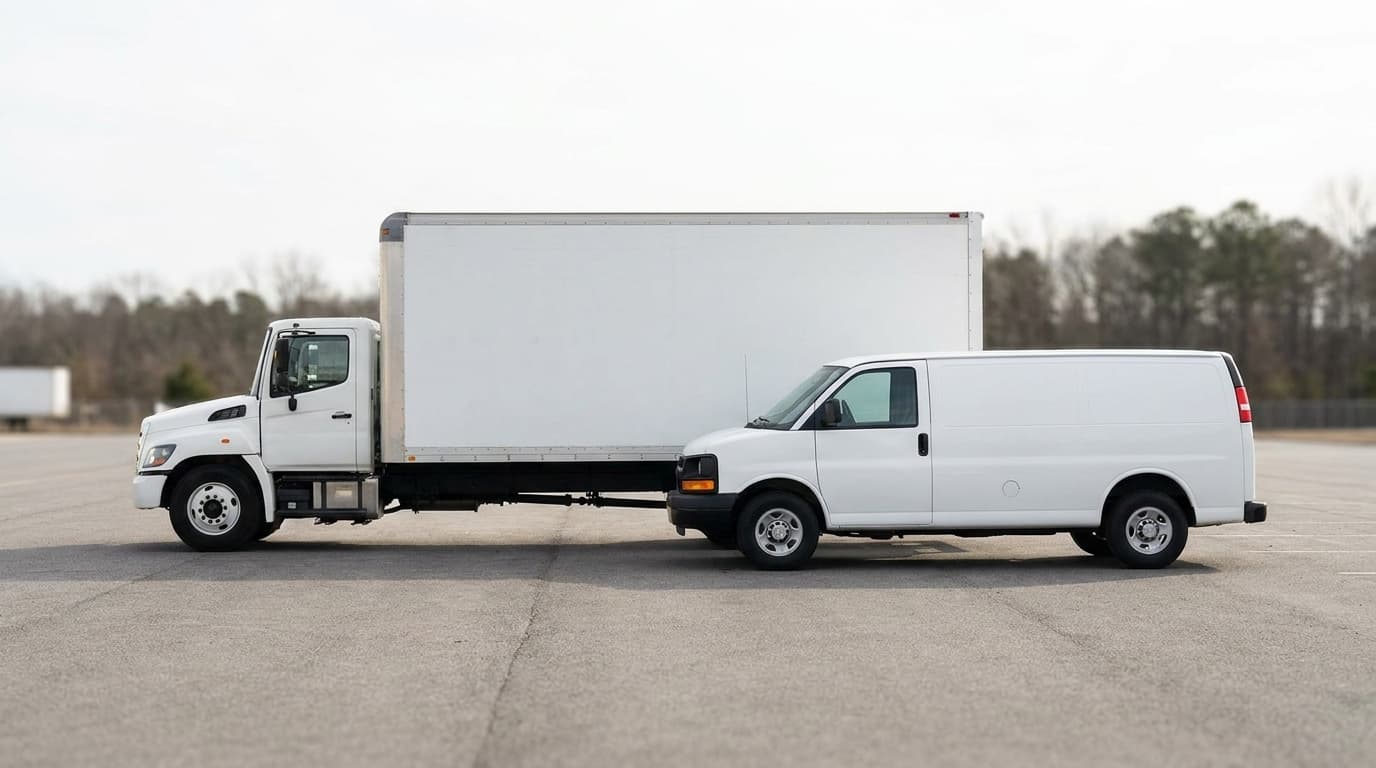
The next size up is the small box truck: a 10-footer at U-Haul, or a 12-footer as the smallest option at Penske. It's the first vehicle that looks like a "moving truck," with a roll-up rear door and, on most models, space over the cab. Here's how the two compare:
| Cargo van | Small box truck (10–12') | |
|---|---|---|
| Cargo volume | ~245–300 cu ft | ~380–450 cu ft |
| Realistically holds | Studio, dorm, light 1-bedroom | Full 1-bedroom |
| Space over the cab | None | Yes (a big bonus) |
| Ceiling height | Lower (no standing) | Taller (easier to stack) |
| Drives like | A large passenger van | A small truck |
| Loading | Step up, no ramp on many | Ramp or low liftgate |
| Fuel economy | Best on the lot | Good, but thirstier |
| Rental cost | Lowest | A bit more |
| Parking | Fits most car spots | Needs a truck-sized spot |
The headline difference is capacity: the small truck holds roughly a third to a half more than the van, and it uses that space better thanks to a taller ceiling and the shelf above the cab, where mattresses, cushions, and light boxes ride so the floor stays clear for heavy items. The van's edge is everything around the cargo: it's cheaper, more fuel-efficient, and far less intimidating to drive and park.
When a cargo van is genuinely enough
A van is the smart, money-saving choice more often than people assume. Reach for it when most of these are true:
- Your load is small. A studio, a dorm, or a one-bedroom without much heavy furniture.
- A second trip is fine. On a local move, running the van twice is often still cheaper and easier than renting a truck once. No ramp, no oversized parking, better gas mileage on every mile.
- Parking is tight. In a dense city with narrow streets and no loading dock, a van slides into spots a box truck can't touch.
- You want it to drive like a big car. A van doesn't have the height, blind spots, or stopping distance of a box truck. If you've never driven anything large, that peace of mind is worth a lot.
- You're watching the budget. The van is the cheapest vehicle on the lot to rent, and it burns the least fuel getting there.
That combination of a lower rental rate plus better mileage is why a van can win even when a small truck would technically fit. On a short local move, the fuel savings alone can offset a second trip. For how the sizes compare on price, see our moving truck rental cost guide.
Students, in particular, are prime van candidates: a dorm or shared-apartment move rarely needs anything bigger. Our college move truck rental guide digs into that case.
When to step up to a box truck
There's a clear line where the van stops making sense and the smallest truck becomes the right call. Step up when:
- You have real furniture. A full sofa or sectional, a queen or king bed with box spring, a dresser, a dining set, a desk. A couple of those together already crowd a van.
- You're moving a full one-bedroom or more. The small truck exists precisely for the one-bedroom that a van can't quite swallow. Anything larger than that isn't a van conversation at all.
- It's a one-way move where a second trip is impossible. This is the big one. On a local move, a too-small van just means driving back for a second load. On a one-way move to another city, there is no second trip. Whatever doesn't fit gets left behind or shipped separately at real expense. When in doubt on a one-way, size up.
- You want the loading to be easier. A taller ceiling and the over-cab shelf make it much simpler to build a stable, well-secured load instead of cramming a van floor to roof.
The pattern here mirrors our general sizing advice: too big costs you a little; too small can cost you the whole day. If you're truly on the fence between a van and a small truck, the truck is the safer bet, especially when you can't just come back for the rest.
The van's trade-offs (and its perks)
Every choice cuts both ways. Know what you're giving up and what you're gaining.
What you give up with a van:
- No over-cab space. A box truck's shelf above the cab is free capacity a van doesn't have.
- A lower ceiling. You can't stack as high, so tall or bulky items eat the floor.
- Less overall capacity. It's the smallest option, full stop.
What you gain with a van:
- It's easy to drive. Closer to a large car than a truck, with better visibility and normal stopping distance.
- It's cheaper to rent and more fuel-efficient. Fewer dollars at the counter and at the pump.
- Loading can be simpler. Many vans load at a low step height with no ramp to climb, a real back-saver for boxes.
None of these are dealbreakers on their own. They're the reasons a van is the right tool for a small job and the wrong tool for a big one.
A note on availability
One practical wrinkle: cargo van availability differs for local versus one-way moves. Vans are common and easy to book for round-trip local rentals, the workhorses of the same-city move. For a one-way rental to another city, van availability can be thinner and more location-dependent, since companies manage their one-way fleets differently.
If you want a van for a one-way move, book early and keep the small truck as a backup. And walk in already knowing the basics. Our step-by-step rental guide covers the whole process, one-way included.
Choose the van if / choose the truck if
Choose the cargo van if:
- You're moving a studio, dorm, or lightly furnished one-bedroom
- Your load is mostly boxes and soft items, not heavy furniture
- It's a local move where a second trip is no big deal
- You're driving through a tight, dense city with limited parking
- You want the lowest price and the best gas mileage
- You'd rather drive something that handles like a large car
Choose the small box truck if:
- You have real furniture: sofa, full bed set, dresser, dining table
- You're moving a full one-bedroom or anything larger
- It's a one-way move where a second trip is impossible
- You want the over-cab space and taller ceiling for easier stacking
- You're genuinely between sizes and can't risk coming up short
The bottom line
A cargo van is one of the most underused options in moving. It's perfect for a studio, a dorm, or a light one-bedroom, and cheaper and easier than a truck every step of the way. But it's the smallest thing on the lot, and it fills up fast once real furniture enters the picture. Match the van to a small load and a forgiving local move; step up to the smallest box truck when the furniture is real or the trip is one-way and unrepeatable.
Not sure which side of the line you're on? Run your home through the truck size calculator for a recommendation in seconds, then compare prices across U-Haul, Penske, and Budget for whichever one fits.
Not sure which truck to book?
Answer two quick questions and get a size recommendation, plus a side-by-side of how U-Haul, Penske, and Budget stack up.